Friday, July 8, 2016

Card Analysis - Core Criminal

Last time, we examined the Anarch cards out of the core set, and found that there's a great deal of potential.  This time, we delve into the Criminal faction cards.

Gabriel Santiago: Consummate Professional
Out of the core box, Gabriel offers a fairly good idea into what the Criminal faction excels at: hitting HQ and making money.  The first time each turn you make a successful run on HQ, you gain 2 credits.  Note that you gain those credits as soon as the run is successful, so they are added to your credit pool before you access any cards, which can help in trashing an asset or upgrade, or paying a cost for certain agendas.  Because of this effect, you'll want to have synergy with cards that help you get into HQ or reward you for getting into HQ.  However, since you're playing Criminal, the corporation will know you are likely to try and take advantage of this situation, and will likely protect HQ and Archives first.  Still, your advantage is in being able to attack early and force the Corporation to spend money.  If you can win the economy game, then you should be able to control the flow of the game.

Trivia: Gabriel Santiago is one of the playable characters in the board game Android: Infiltration.  But unless you are playing the Specialists variant, there's nothing to mechanically distinguish him from the other characters.

Pair cards: Account Siphon, Inside Job, Desperado, Sneakdoor Beta, HQ Interface, Legwork

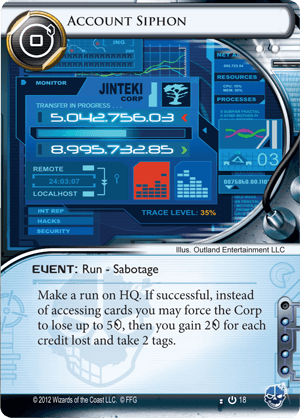
 Account Siphon
Continuing to exemplify the criminal idea.  This event makes you run on HQ, and if it is successful, you can force the corporation to lose up to 5 credits, then you gain 2 credits for each credit the corporation lost, giving a potential gain of 10 credits.  But if you exercise this option, you have to take 2 tags.  The big thing about this is that if the corporation is low on credits, making them lose all of them can open up other possibilities of attack, since they now can't afford to rez most ice.  Just be aware that the corporation does have an opportunity before the run is successful to spend their credits to rez assets and upgrades.  As such, you are free to choose not to use this ability.

Trivia: Not exactly a reprint of any Netrunner CCG card, but there is a close match in Edited Shipping Manifests, which has the same effect, only you force the corporation to lose 1 credit and gain 10 credit, then take one tag.

Pair cards: Desperado, NetworkingSame Old Thing, Lawyer Up, Maya

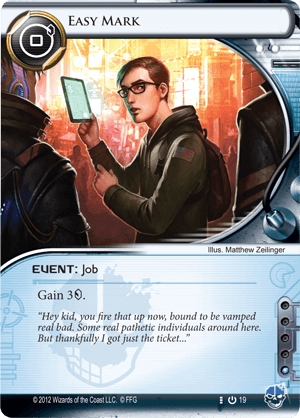
Easy Mark
This card used to be very staple economy for Criminals, or anyone who wants to spend the influence to add it.  While the credit gain isn't nearly as great as other economy options, the main thing about this one is that it costs nothing to play, so if you've burned through all your credits installing cards or you had to spend it all on a run, this one will bring you back up to 3.

Trivia: We've got another reprint from Netrunner CCG here.  In this case, the old card was called Livewire's Contacts.

Pair cards: Anything really.  This one kind of stands on its own.

Forged Activation Orders
An amazing operation that forces the corporation to make a tough decision: do they rez a piece of ice, which may cost them credits that they need, or do they trash it, making it potentially easier for you to assault that server?  Usually, either option will benefit you, unless you blindly pick a cheap piece of ice.  As such, you should probably consider cards with expose effects so you can find something that you want out of the way.

Trivia: A direct reprint from Netrunner CCG this time, right down to the name and cost.  Here's a link to the classic Forged Activation Orders.

Pair cards: Infiltration, Lemuria Codecracker, Satellite UplinkEmergency Shutdown

Inside Job
Is the corporation trying to defend their agenda with just one piece of ice?  Punish them for that idea with this card.  Bypassing a piece means that you don't have to interact with it, which is good for getting around large ice that would otherwise be expensive to deal with.  This can save you a great deal of money on a run.

Trivia: Another direct reprint from Netrunner CCG.  Here's the classic Inside Job.

Pair cards: Same Old Thing, Public Terminal, Planned Assault


Special Order
Another tutor card.  This one lets you take any icebreaker of your choice out of your deck and put it into your hand.  This can be very helpful if the corporation is defending their servers with one type of ice, or you just need that one last icebreaker to complete your rig.

Trivia: We have a fairly close card here to a classic Netrunner CCG card.  Temple Microcode Outlet lets you search your deck for any program, though.  Perhaps the developers thought that was a little too powerful an effect for that cost.

Pair cards: Icebreakers, Prepaid VoicePAD

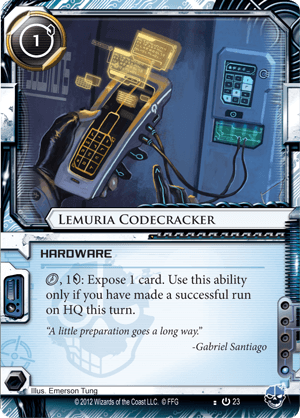
Lemuria Codecracker
This card is frequently overlooked, mostly because of the requirement built into its effect.  If you have made a successful run on HQ on the same turn, you can spend a click and a credit to expose any one card.  I suppose the big problem with this is the time cost, since Infiltration accomplishes the same effect for free without needing a successful run on HQ first.  Still, the advantage this has over Infiltration is that it's highly reusable.

Trivia: Not quite a reprint, but the classic Netrunner CCG card SeeYa has the same effect, only without requiring a successful run on HQ.  And it's a program instead of hardware.

Pair cards: Sneakdoor Beta, Feint, Blackguard

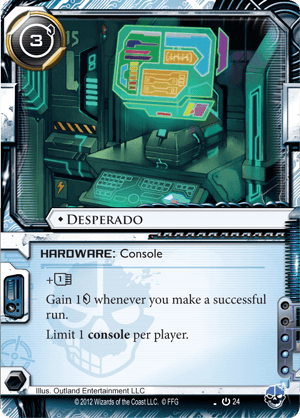
Desperado
I'm fairly certain this is supposed to be Gabriel's console, given the name.  But anyway, this is the console to which all other Criminal consoles are compared.  It gives you 1 extra memory, but the main effect is gaining 1 credit whenever you make a successful run.  Pairing this up with other effects that trigger on successful runs can net you a great economic advantage.  But this economic advantage is what ultimately led to this card being placed onto the NAPD Most Wanted List.

Pair cards: Datasucker, Dirty Laundry, John Masanori

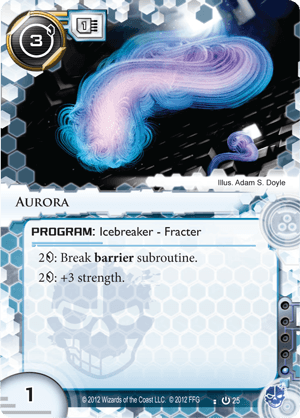
Aurora
We come to the first of the Criminal icebreakers.  The big problem with Aurora over Corroder is in the cost to break subroutines: 2 credits instead of 1.  The only real advantage this has over Corroder is the slight efficiency of gaining 3 strength for 2 credits, but that can be a downside, since Corroder can start breaking strength 2 barriers without having to pumps, whereas this has to spend 2 credits before it can interact with those strength 2 barriers.  I suppose the only real reason to take this is if you will be making large enough piles of cash to utilize it and you don't have the influence for Corroder.

Pair cards: E3 Feedback Implants

Femme Fatale
This lady is highly useful.  While she can be used to break sentries, anything that requires pumping her strength extensively will become very expensive fast.  Her true potential lies in her ability to select a piece of ice when she is installed.  Whenever you encounter that piece of ice, you can bypass it by paying 1 credit for each subroutine on that piece of ice.  The can let you get past an expensive piece of ice cheaply.  Of course, the corporation may choose to trash that piece of ice, so the ability can be lost.

Trivia: We don't have an exact reprint here, but the Netrunner CCG card Black Widow comes fairly close.  The statistics on this card are the same as Femme Fatale, but instead of being able to bypass a piece of ice, Black Window gains 5 strength during encounters with the selected piece of ice.  Of course, if the piece of ice isn't a sentry, that doesn't help you much.

Pair cards: Test Run, Scavenge

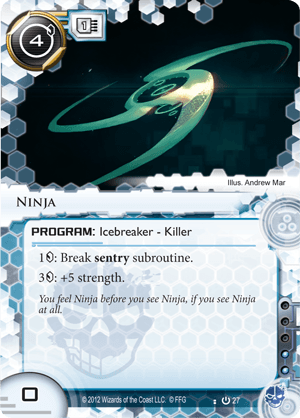
Ninja
Between Femme Fatale and Ninja, it becomes apparent that the Criminal faction is designed to deal with sentries.  Ninja is very efficient, gaining 5 strength for only 3 credits.  Plus, it breaks subroutines for only 1 credit.  The downside to this is that many sentries will end up costing you 4 or 5 credits due to this.

Pair cards: Datasucker, Ice Carver, The Personal Touch, Dinosaurus

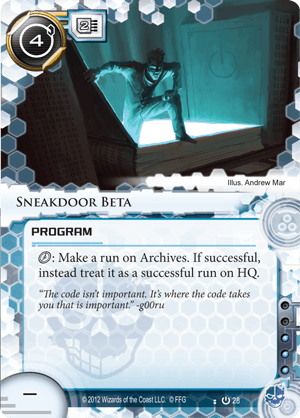
Sneakdoor Beta
This can really catch your opponents off guard.  Installing this program forces your opponent to defend Archives, since now you can turn successful runs on Archives into successful runs on HQ.  The only downside is that this program takes up 2 memory, so you'll want your console or some memory chips installed.

Trivia: It turns out this is a reprint.  From the Netrunner CCG, we have Shredder Uplink Protocol, which has the same install cost, memory requirement, and effect.

Pair with: HQ Interface, Emergency Shutdown

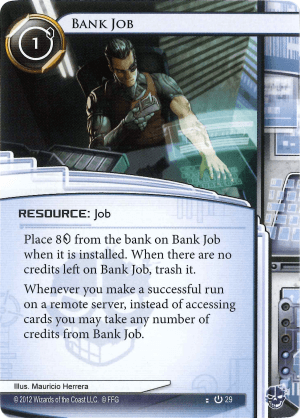
Bank Job
If the corporations you are playing against are leaving their assets unprotected, you can make a lot of money off of them.  At the cost of 1 credit, you could gain 8 credits on a successful run against a remote server.  Of course, nothing is forcing you to take all of those credits off of this card.

Pair cards: Aesop's Pawnshop

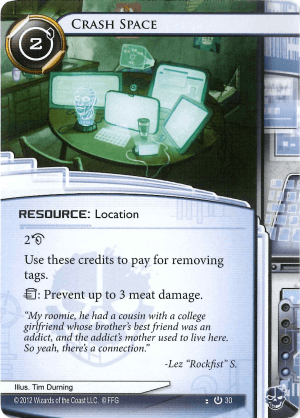
Crash Space
This is actually fairly useful.  If you know you are going to be taking tags, the having 2 recurring credits to pay for removing them is highly useful.  Plus, this can be trashed to prevent 3 meat damage, which means that if the corporation is trying to kill you that way, the may be force to deal with this card first.

Trivia: In the Netrunner CCG, Crash Space is also a resource, but it has a much different effect.  It gives you a credit at the start of each turn, but all trace attempts by the corporation automatically succeed and give you a tag in addition to other effects.  Plus, if the classic Crash Space leaves play, you lose 2 credits.

Pair cards: Account Siphon, VampCode Siphon

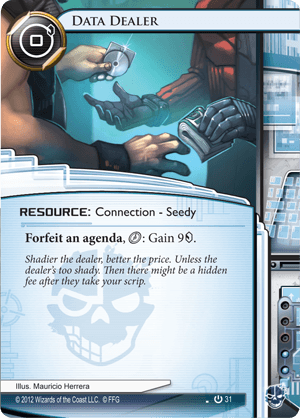
Data Dealer
At first glance, the idea of giving up an agenda seems like a bad idea.  Still, this is one of the largest burst economy effects in the game, and the most efficient per click.  Plus, it lets you get rid of the negative effects of Shi.Kyū and News Team while making a massive profit.

Trivia: We have an almost reprint here.  The classic Netrunner CCG card Databroker is almost identical to this one, except that you forfeit an agenda point to gain 10 credits.  I guess it was just too much hassle to force players to track agenda points separately from agendas scored or stolen.

Pair cards: Notoriety, Fan Site

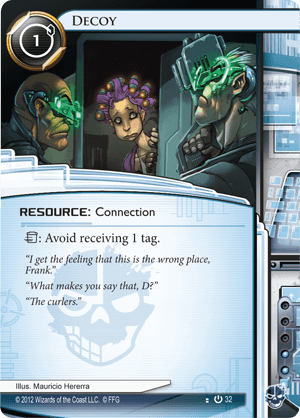
Decoy
 This is pretty explanatory.  For 1 credit, you get a card that allows you to avoid 1 tag once.  You may be wondering, "Why not just remove the tag afterwards?"  Well, there are cards that trigger off of you receiving a tag (Rachel Beckman), or having a tag at a specific time (Dedicated Response Team), which can cause problems.  As such, avoiding the tag altogether may be a better option in those cases.

Pair cards: Calling in Favors, Armand "Geist" Walker: Tech Lord

Well, that does it for the Criminal Core Set cards.  Next time, we'll look over the Shaper Core Set cards.

Wednesday, July 6, 2016

Card Analysis - Core Anarch

When I first started up this blog, one of the possible article types I had hinted at was analysis of cards from the various sets.  Almost immediately after that post, I found the blog Wyldside, which was dedicated to the exact same thing.  As such, I felt I didn't really need to do the analysis.  However, it has been almost a year now since Wyldside was last updated, having stopped partway through the Genesis cycle.  So, while I know it has already been done to death to review individual cards, I figure I may as well give my own take on the idea.

But there will be some differences between me and other reviewers.  I will not be ranking or scoring cards.  Almost all rankings of cards agree on which cards are good and which are bad, taking into consideration either the card in a vacuum or the card in combination with other cards.  I'm of the opinion that every card has possibilities, and to ignore those possibilities just because the card does little on its own is to do a disservice to the design.  As such, each card I go over will include a list of recommendations of other cards to pair with it in order to improve the card's potential.

That being said, let's start with the beginning: the Core Set Anarch cards.

Noise: Hacker Extraordinaire
Noise is the archetype when you consider the Anarch faction in Netrunner.  His goal is to destroy the corporation, one card at a time.  He does this by launching a swarm of viruses, which eat away at the corporation's research computers.

While initially Noise was considered one of the weakest runners, he has developed over time into becoming one of the most powerful.  Every time a new virus is released, his toolset improves.  Plus, he has in-faction access to a console designed specifically to work with viruses.  But since we'll be getting to that console later in this article, we'll discuss that more then.

Trivia: Noise is one of the potential murder suspects in the Android board game.  Is he a cold-blooded killer, or did he hire the person who did the deed, or is he being framed?

Pair cards: Viruses, Grimoire, Keyhole

Déjà Vu
It's interesting.  This is the first form of recursion in the game.  While there are now forms of recursion that grant you your entire deck back, or let you install cards from your discard pile, this one is still rather good.  For 2 credits, you can get any one card or two virus cards from your discard pile into your hand.  Of course, this majorly benefits Noise, but can be used with anybody who utilizes viruses.

Pair cards: Noise, Viruses

Demolition Run
Again, the idea of Anarch being about destroying the corporation is reinforced here.  You make a run where you can trash any cards you access, even if the can't normally be trashed, for free.  Of course, to get the most use out of this, you'll want to be able to access as many cards as possible during this one run.

Pair cards: Medium, Nerve Agent, HQ Interface, R&D Interface

Stimhack
This card works very well as a surprise.  The corporation may think that their server is unassailable due to their large amount of ice, but the 9 temporary credits gives you a great jump in cash.  The big downside is the one unpreventable brain damage at the end of the run.  Plus, any of those 9 credits you don't use are lost.

Trivia: We have here one of the first reprints of cards from the Netrunner CCG.  Originally, this card was called Lucidrine™ Booster Drug.

Pair cards: Personal Workshop

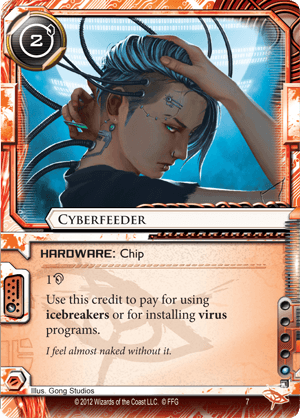
Cyberfeeder
The big thing about recurring credits is that you receive them at the start of your turn.  As such, the more recurring credits you spend, the more credits you are keeping in your credit pool, which means those credits can be used for other costs, such as paying for icebreakers, or trashing cards, or boosting link, or whatever you need.  In this case, Cyberfeeder does double duty.  Its one credit can be used to either pay for installing a virus card or for using icebreakers.  And remember, that credit doesn't have to be spent for pumping the icebreaker or breaking a subroutine.  It can be used with any paid ability or effect, such as the ability to bypass ice with Femme Fatale or placing virus counters on Darwin.

Pair cards: Viruses, icebreakers

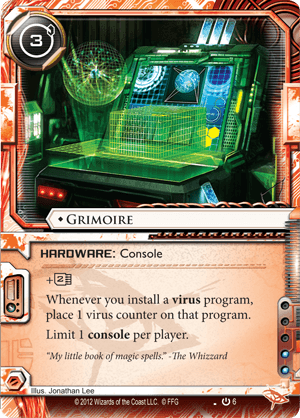
Grimoire
As I alluded to earlier, this is the console that Noise will almost always be running.  In fact, this console can work well for anybody.  For 3 credits, you gain +2 Memory Units, and whenever you install a virus program, you place a counter onto that program.  With Medium or Nerve Agent, it means that you can access an extra card on the first run after installing it.  With Imp, you gain the potential to trash an additional card.  With Cache you gain an extra credit.

The only problem I have with this card is that the flavor text states that the console belongs to Whizzard, and yet it works much better for Noise.

Pair cards: Noise, viruses, anyone who needs extra MU

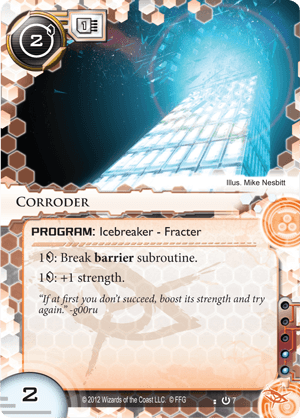
Corroder
Quite possibly the standard by which all Fracter icebreakers are judged by.  It's cheap to install, and it has the highest efficiency, costing only 1 credit to increase strength or break a subroutine.  The trade off here is that it starts with only 2 strength, but most of the common barrier ice you will see will be within easy reach of this program.

Trivia: We have a potential reprint here.  Hammer from Netrunner CCG has the exact same statisticts as Corroder, but since the Noisy mechanic isn't in this version, it's not an exact copy.

Pair cards: Datasucker, Cyberfeeder, Dyson Fractal Generator

Datasucker
Again, this also works to define the Anarch idea.  This program builds up counters each time you make a successful run on a central server (R&D, HQ, or Archives,) and each counter can be spent during an encounter with a piece of ice to lower the strength of that ice by 1 for the remainder of the encounter.  This can be used as an alternate economy, letting you save your credits, or it can be used for one of the most fearsome options Anarchs have in their arsenal: ice destruction.

Pair cards: Grimoire, Parasite

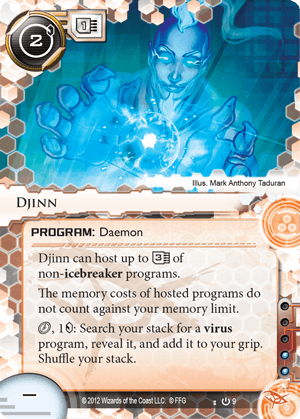
Djinn
The very first Daemon in the game.  In addition to giving you extra space for storing programs that aren't icebreakers, Djinn allows you to search your deck (sometimes called tutoring, from a series of cards in Magic: the Gathering that let you search your deck) for a virus card, and then add it to your hand.  This makes Djinn a good place to store your viruses, but take care to protect it, as if it is trashed, all the hosted programs are trashed as well.

Pair cards: Noise, viruses, Cyberfeeder

Medium
The first option for multi-access in Runner.  Each counter on it after the first allows you to access an additional card from R&D when you access R&D.  Also, you place a counter on it when you make a
 successful run on R&D, so the more times you make successful runs on R&D, the more cards you can see.  Plus, the ability is optional, so you are not forced to look at additional cards while using this, in case you fear that there may be a Snare! waiting for you.

Oh, and if you have multiple Mediums installed simultaneously, then both apply,  If they both have 2 counters on each of them, you can access up to 3 cards.

Trivia: Another reprint from Netrunner CCG.  This one was originally called Highlighter.

Pair cards: Noise, Grimoire, Cyberfeeder

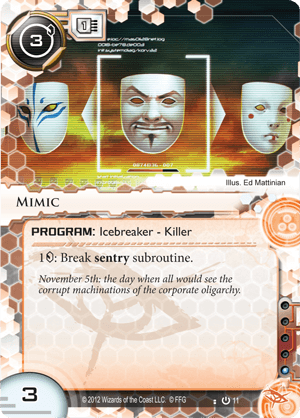
Mimic
Kind of another staple of Anarch: the fixed strength breaker.  For 3 credits, you can break any sentry ice that has strength of 3 or lower.  But with Datasucker in play, you could break sentries with even higher strength than that.

Trivia: Another reprint, sort of.  The Netrunner CCG card Codeslinger has the exact same statistics, except for its 7 credit install cost.  Aren't you glad Mimic is so much cheaper?  Also, the flavor text is a reference to November 5th, Guy Fawkes' Day, where a group conspired to blow up the British Parliment.  The artwork references the masks the conspirators wore, which have since been adopted by hacker group Anonymous.

Pair cards: Datasucker, Parasite, The Personal Touch, Dinosaurus, Net-Ready Eyes

Parasite
Once again, reinforcing the Anarch idea of destruction.  This card is attached to a piece of rezzed ice and slowly drains the strength of that ice.  And if that piece of ice is reduced to 0 strength, then Parasite trashes it.  Just remember that since it has to be hosted onto a piece of ice, you can't host it on your Djinn or other Daemon at the same time.  The sheer destructive power of this card combined with the ease of recursion now available are what resulted in this card being put onto the NAPD Most Wanted List, effectively making it an additional influence out of faction, or 1 influence in Anarch.

Pair cards: Noise, Déjà Vu, Datasucker, Clone Chip

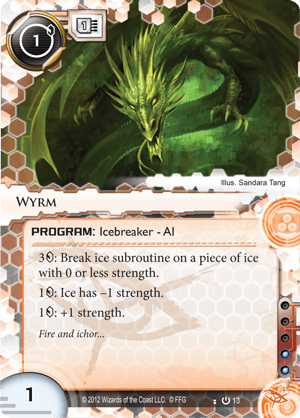
Wyrm
You don't actually see Wyrm that much.  While it is cheap to install and its status as an AI icebreaker means it can deal with anything, the main problem is in its costs to use.  First, in order to interact with a piece of ice, you have to pump Wyrm's strength up to match that piece of ice.  Then, you have to use Wyrm to reduced that piece of ice down to 0 strength.  Finally, you can now spend 3 credits per subroutine you wish to break on that piece of ice.  As such, Wyrm is more often used in conjunction with Parasite for ice destruction.

Pair cards: Datasucker, Parasite, Cyberfeeder

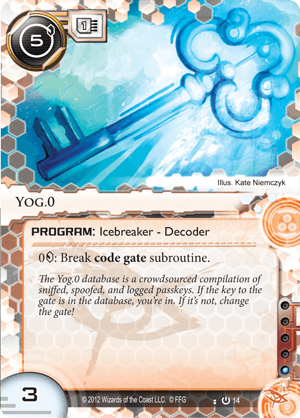
Yog.0
Another fixed strength icebreaker for Anarchs, this time breaking code gates.  Alone, this lets you break any 3 strength or lower code gate for free, making a lot of code gates useless.  But combined with reducing ice strength or boosting this cards strength and you can make even more code gates less than stellar.  The sheer power of this ability led to this card being placed onto the NAPD Most Wanted List.

Trivia: Another direct reprint from Netrunner CCG, where it was originally called Tinweasel.  Also, a possible H.P. Lovecraft reference to Yog-Sothoth, known as the keeper of gates.

Pair cards: Datasucker, Dinosaurus, Net-Ready Eyes

Ice Carver
Again, reinforcing the archetype of weakening and potentially destroying ice.  For 3 credits, all ice is encounted with strength lowered by 1.  This means that Parasite needs 1 fewer counter to destroy a piece of ice.  Plus, it improves the utility of the fixed strength breaker suite.  Just be aware that this resource is unique, so you can't have more than one copy installed.

Trivia: Not exactly a direct reprint from Netrunner CCG, although that game does have a program called Clown with the exact same effect.  But Clown isn't unique, so you could have multiple copies of it installed.

Pairs with: Parasite, fixed-strength icebreakers

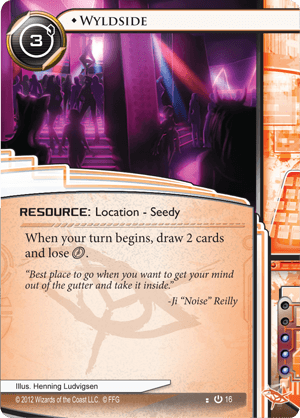
Wyldside
The main thing about this card is click efficiency.  The more you can get out of each click, the more potential advantage you can get.  Normally, in order to draw two cards, you would have to spend two clicks.  But with Wyldside, at the cost of losing a click, you get to draw two cards at the start of your turn.  If you can keep drawing cards, that can turn into a massive advantage.

Update: As of July 12, 2016, Wyldside is now on the NAPD Most Wanted List.  So if you're an Anarch player, keeping this in will mean having to make hard choices on your influence.

Trivia: A nightclub on the moon catering to genetically modified humanoids with animal features.  Also, where the aforementioned blog derived its name from.

Pair cards: Adjusted Chronotype, Faust

And that does it for the Core Set Anarch cards.  Next time, we'll examine the Core Set Criminal cards.

Friday, June 17, 2016

Colorado 2016 Regional Tournament Report

It's been almost a week since the Colorado Regional Tournament for Netrunner, and I feel I'm still working through what happened.  While I don't go into tournaments expecting to crush everyone, I would at least like to see my ideas work.  At any rate, here's what I came up with this time:

Consume All Data - 46 cards
Identity: Apex - Invasive Predator

Programs
D4v1d - 2 (8 influence)
Endless Hunger - 3
Harbinger - 3
Mimic - 2 (2 influence)

Hardware
Clone Chip - 1 (2 influence, -1 max influence)
Dyson Mem Chip - 3
e3 Feedback Implants - 2 (4 influence)
Heartbeat - 3
Plascrete Carapace - 3

Resources
Hunting Grounds - 3
The Turning Wheel - 3
Wasteland - 3

Events
Apocalypse - 3
Dirty Laundry - 3
Levy AR Lab Access - 1 (3 influence)
Prey - 3
Quality Time - 2 (2 influence)
Sure Gamble - 3

My theory here is that diversifying the breaker suite should allow Apex to get through more troubling ice.  Endless Hunger and e3 Feedback Implants allow you to get through anything that has at least one "End the run" subroutine.  D4V1D allows you to deal with high strength ice that doesn't have any "End the run" subroutines, such as Assassin or Turing on a remote.  Mimic deals with low strength sentries that don't have "End the run" subroutines, such as Cobra.  Plus D4V1D has the added benefit of hanging around once its counters are gone, so it can then be used for Endless Hunger or Heartbeat.

Clone Chip gives you a bit more flexibility, especially if you lose a key program during a run.  Plus, it can let you recur a spent D4V1D.  Dyson Mem Chip is needed to run the full suite, as the +1 memory from Heartbeat isn't enough to hold Endless Hunger, Mimic, and D4V1D simultaneously.

The Turning Wheel seems promising in isolation.  I suspect that this card will be eventually changed with errata so that it only can place a counter from a successful run, but for now, you can run repeatedly into an ice on HQ or R&D that just ends the run to build up counters on this for a massive dig.  I'm wondering how well this might work in a Criminal deck that takes advantage of Snitch and Au Revoir to make piles of cash.

Last point I want to discuss is the two copies of Quality Time.  Originally, I was using Grifter instead, since that gives me money for running, which feels like something the deck should be doing anyway.  I swapped Grifter out for Quality Time to add card draw into the deck.  But still, I end up drawing a lot of cards by spending clicks, and it feels like I no longer have sufficient economy for this deck.

General Hospital - 44 cards
Identity: Harmony Medtech - Biomedical Pioneer

Agendas - 18 points
Global Food Initiative - 3 (3 influence)
The Future Perfect - 3

Ice
Crick - 2
Komainu - 2
Lotus Field - 3
Susanoo-no-Mikoto - 1
Swordsman - 1
Wall of Static - 3
Wall of Thorns - 2

Assets
Jackson Howard - 3 (3 influence)
Mental Health Clinic - 3
Shi.Kyū - 3

Upgrades
Ash 2X3ZB9CY - 3 (6 influence)
Caprice Nisei - 3

Operations
Cerebral Static - 3
Hedge Fund - 3
Medical Research Fundraiser - 3

As I have stated on the page for this deck, there is nothing original about this deck.  It's the Jinteki 6 agenda deck, just for slightly modern times.  GFI takes the place of whatever was being used before Data and Destiny came out (I think it was the Source Code fragments, but I could be remembering incorrectly.)

Ice suite is supposed to be kind of diverse.  I went with Crick hoping I could use it to get some key upgrades or assets back.  Komainu should hurt the runner, and has a kind of synergy with Mental Health Clinic, since the more cards the runner has, the more it will cost them to get through this.  Lotus Field can stop a runner early, and can't be affected by Parasite or Datasucker.  Susanoo is supposed to go on your scoring remote, but can be placed anywhere except Archives.  Swordsman is a one off to deal with Faust.  Wall of Static and Wall of Thorns provide some more EtR ice.

I've gone with Mental Health Clinic instead of other drip asset economy mostly because it's cheap to rez and I don't care much about how many cards the runner can hold.  I've also picked Medical Research Fundraiser over Celebrity Gift because I don't have enough traps to make Celebrity Gift worthwhile and I don't care about how many credits the runner has.  In theory, Ash and Caprice should be able to defend the scoring server, making the amount of money the runner has a little less relevant.

So those are my decks.  Let's get on to how badly I did.

Round 1: vs. Marty
Harmony Medtech vs. Valencia Estavez: 3 - 3 L (milled)
Apex vs. Argus Security: 2 - 7 L

Both of these early games were fairly fast.  My early attempts to defend in game 1 were in vain, as the combination of Blackmail and DDoS left me unable to stop an Apocalypse.  I was able to rebuild after that, and even scored a GFI.  However, he still took the other two, and though I did get two Shi.Kyu onto him, he burned one off thanks to Frame Job.  After that, he was able to get Eater and Keyhole out and started burning me down.  I can't remember if my Swordsman was just burned, or if I put it onto Archives, thinking he would be sure to run there.  I suppose instead Swordsman should have gone onto R&D if I had it.  End of that game I had a TFP in a remote, with no money to score it, and getting milled out anyway.  Second game was frustrating.  I was unable to find my breakers, which gave him the time to rush out 4 points.  I did snag a Project Atlas off of R&D, but he was still able to rush out the last of the points.

Round 2: vs. Andy
Apex vs. Gagarin Deep Space: 4 - 7 L
Harmony Medtech vs. Nasir Meidan: 6 - 0 W

I play against Andy fairly regularly, so it's interesting to see what directions he goes in.  Game one in theory should have been a good match-up for me, but I don't think I saw a single copy of Apocalypse in the game.  Or if I did, I installed it face down, thinking another one would come up later.  As such, I was unable to adequately deal with the large amount of assets, ended up running out of cash, and lost the game because I ran into an Ash without money.  Game two was much better.  He went broke installing out equipment, so I put both Ash and Caprice onto the scoring server, and just didn't even bother bringing ice online.  Won with two GFIs on this one.

Round 3: vs. Aaron
Harmony Medtech vs. The Professor: 0 - 6 L
Apex vs. NEXT Design: 2 - 7 L

I have no notes on this match, as it put me into tilt.  What I do remember is that game one went very badly.  He was able to get his setup quick enough that nothing I did mattered.  Game two started off poorly.  He scored out an Accelerated Beta Test, building up his defenses.  I was able to land an Apocalypse after that, but he still rebuilt much more easily than I did.  Once again, I believe I ran out of cash, giving him the game.

Round 4: vs. Brian
Apex vs. Near-Earth Hub: 6 - 7 L
Harmony Medtech vs. Ken "Express" Tenma: 6 - 2 W

One again, ended up losing a game as Apex that should have been a good match-up for me.  I ended up having to dig through most of my deck in order to find the first copy of Endless Hunger.  Before that, I was able to put some pressure onto R&D thanks to D4V1D, since he chose to protect it with Little Engine, which had the added benefit of giving me extra cash.  I think I ended up snagging two copies of Explode-a-palooza and one AstroScript Pilot Program, but he got up to 6 points as well.  I tried digging for the last one in R&D, but he ended up scoring out a 3 for 2 agenda thanks to SanSan City Grid.  Second game was better for me.  I was able to drain out his money, and while he was able to nab one GFI, he messed up using The Maker's Eye at one point where he couldn't get in.  As such, I managed to score out a GFI and a TFP.

Round 5: vs. Natalie
Harmony vs. Hayley Kaplan: 3 - 6 L
Apex vs. Building a Better World: 7 - 4 W

First game, I was able to get a Cerebral Static off on the second turn, which turned out to be the right play, since she spent the first turn building up money through events.  Unfortunately, her deck turned my own against me.  She took a Shi.Kyu only to turn it around with Liberated Chela and Hyperdriver.  Plus, the moment I started setting up my scoring server with Wall of Thorns, she managed to get out a Morning Star onto a NetChip, making my barriers nearly useless.  She then got out a Garrote and a Torch, the latter making my Lotus Fields nearly useless.  After that, she took a GFI from me and was able to install two more Hyperdrivers, two more Liberated Chela, and all three of Fan Site, making it impossible for me to win.  I decided to score out the one GFI, which gave her the Fan Sites.  Her final turn was burning the Hyperdrivers to give herself 10 clicks for the turn, which would let her use both Liberated Chelas if needed.  I decided to not even bother forfeiting for the first one.  Game two was interesting.  I suppose I should have known this was the 6 agenda deck.  I did end up having enough time to build up my rig.  As such, she was able to get an early Hostile Takeover.  After that, I thought I was fortunate to snag a Vanity Project off of R&D, but that ended up being taken from me, thanks to the combination of Consulting Visit, SEA Source and Exchange of Information.  After that, I built up counters on The Turning Wheel by running into a Meru Mati on HQ repeatedly, then made a run on HQ hoping to dig out agendas.  By luck, the first card I pulled was Government Takeover, giving me the game.

Post-Game Analysis

Thinking on this, I won the corp games where I was able to keep the runner poor.  As such, I should reconsider ice to be more taxing.  I should also probably reconsider Biomedical Research Fundraiser.  Finally, I may want to reconsider Shi.Kyu for something more taxing.  Originally, I was contemplating using News Team instead of Ash, but these cards don't seem to have as much benefit now, since there are so many cards people are utilizing that require the forfeit of agendas.  As for Apex, I still want to reconsider both economy and card draw.  Perhaps I should bring back Chop Bot 3000 for some card draw.  Plus, I may need a better form of drip economy.  Data Folding might be the answer to that, but I would have to bring back Leprechaun to get the space I need.  Or perhaps I should consider Scheherazade to get money from installing programs.

Out of 38 participants, my dismal performance earned me 35th place.

Well, that's all for now.  Until next time, I have no snappy sign-out for you.

Wednesday, June 8, 2016

The Changing Nature of Words

Update: As of July 12, 2016, the Netrunner FAQ has "Swap" as a defined term, wherein two cards exchange position simultaneously,  thereby explaining how swapping devas doesn't count as installing the new one.  Of course, the cards with swap on them that have the word install still count as the new card being installed, because that's how that works.

As such, the lesson is, "Words only mean what the designers say they mean."

If you play Netrunner, you've probably come across (or at least, have heard of,) the Android: Netrunner Comprehensive Unofficial Rules, or ANCUR.  It's a fairly useful resource, allowing players to come up with rulings on cards that have not yet had official rulings on their usage.  Still, I'm of the opinion that they don't always get things right.  Allow me to explain.

On the unofficial ruling page for Democracy and Dogma, there is a ruling from Damon Stone, the lead designer, on Sadyojata.  His claim is that swapping Sadyojata with another Deva icebreaker does not count as installing the new icebreaker.  And while normally his status as lead designer would normally give him a free pass, this particular ruling seems to contradict how they have defined the term "swap."  But to get a better grasp on just how this particular word is used, let's run a search on NetrunnerDB for all cards with the word "swap" in their game text.

And the results are:
Aghora
Allele Repression
Exchange of Information
Jinteki Biotech: Life Imagined
Midori
Mumbad City Grid
Raman Rai
Sadyojata
Surfer
Synthetic Systems: The World Re-imagined
Tenma Line
Toshiyuki Sakai
Turntable
Vamadeva

So let's ignore the three Devas for now, since that's what we're trying to understand.  Also, let's ignore Exchange of Information and Turntable, because agendas in the score pile are not installed.  Still, we need to establish some sort of baseline definition for the word "swap."  To do that, let's start with Jinteki Biotech.

This seems fairly straightforward.  Before the first time of the game, we can switch any copy of Jinteki Biotech for another copy of Jinteki Biotech one time.  Of course, identity cards also aren't installed, but this does give us our baseline definition for "swap:" to exchange one card for another.

With that done, let's examine the remaining cards for understanding.


This card allows the Corporation to switch 1 card in their hand for 1 card in their discard pile for each advancement counter on this card if the card is rezzed and the corp trashes it for cost.  Again, the cards aren't installed, but this allows us to see how swapping works when swapping cards between HQ and Archives.


These three cards all involve swapping installed ice.  Tenma Line specifically says "swap 2 pieces of installed ice."  Mumbad City Grid allows the corp to swap a piece of ice that the runner just passed with another piece of ice protecting the server.  Surfer allows the runner to swap a piece of barrier ice currently being encountered with another piece of ice directly before or after it.  In all three cases, two installed cards are being swapped, so logically, we can deduce that the cards are not considered to be installed when swapped if they are already installed to begin with.


Now it gets interesting.  Both Midori and Toshiyuki Sakai say that we can swap an installed card with a card that is from HQ.  This differs from the previous scenarios where we are swapping two cards that are already installed, or swapping cards that are not installed.  Now we are swapping an installed card with a card that is not installed.  But what I think is most telling is the official ruling on these cards from the Android: Netrunner FAQ.  Specifically, page 8 for Midori reads, "Ice that is swapped is installed, but the install cost of the ice being swapped does not have to be paid," and page 10 for Toshiyuki Sakai reads, "The card that is swapped with Toshiyuki Sakai is installed."

So if we were using Midori or Toshiyuki Sakai with Haas-Bioroid: Engineering the Future, these cards would trigger the effect of that identity if it was the first time we installed a card on the Runner's turn.  Based on this, we can logically determine that swapping a card from hand with a card that is already installed means that the new card is considered to be installed.  Yet somehow, we are supposed to believe that the definition of the word "swap" is now different for the Runner than it is for the Corporation.


Of course, all of this is just my opinion.  Damon's ruling stands until the FAQ is updated, which I don't think will happen until Fear the Masses is released.  And to be honest, I'm just hoping that it will turn out this way so that a Deva/LLDS Processor deck would be viable.  As such, take what I say with a grain of salt, and hope that creativity wins out in this case.  Granted, I now see why A Game of Thrones: the Card Game Second Edition needed a Rules Reference Guide which defined practically every term that would be used.  And yet, players still debated on the meaning of "Limited."

Until next time, update your definitions.  Your words no longer mean what you think they mean.

Tuesday, May 31, 2016

The Yellow King May 2016 GNK Report

Summer is upon us, and with that, another tournament season.  With the regional tournament for Colorado coming up soon, now is a great time to test deck ideas for that event.  And what better place to test those ideas in a semi-casual Game Night Kit tournament?  At any rate, here are the decks I took to this event:

Swap Meet - 49 cards
Identity: Hayley Kaplan - Universal Scholar

Programs
Garrote - 1 (3 influence)
Self-modifying Code - 3
Snowball - 1
Torch - 1

Hardware
NetChip - 6
Ramujan-reliant 550 BMI - 6 (6 influence)
Replicator - 3
Spy Camera - 6
The Toolbox - 1

Resources
Aesop's Pawnshop - 3
Bazaar - 3
Inside Man - 3
Technical Writer - 3

Events
Diesel - 3
Levy AR Lab Access - 1
Test Run - 3
Trade-In - 2

While I'd like to say that this is a completely original design, much of the inspiration for this came from looking at other decks using Hayley and Consumer-Grade hardware.  The core of the idea is to use Replicator to fill your hand with NetChips, Ramujan-relient 550 BMIs or Spy Cameras, then install them all simultaneously using Bazaar, placing lots of credits onto your Technical Writers in the process, then selling the hardware using Aesop's Pawnshop.  Inside Man helps mitigate the cost of this process.  Because you should be making money every turn, I've gone with more expensive and efficient breakers: Garrote, Snowball, and Torch.  Self-Modifying Code can work as either a tutor or can be sold for money.  I've picked The Toolbox as my console because Comet doesn't work in this deck due to having so few events.  Maya is a possible replacement, but the effect may not trigger frequently.  Astrolabe could also be good, as it might accelerate your installation of hardware.  But for the most part, The Toolbox is there mostly for the recurring credits.  As for events, Diesel is for additional card draw, Test Run can get a program out of your deck or, more importantly, out of your discard pile, Trade-In allows you to pull a specific piece of hardware, say, a different type of Consumer-Grade, and Levy AR Lab Access lets you reinstall all the hardware after you've sold it all.

The basic idea is that you should be able to pressure any scoring remote.  If the corp is playing fast advance, the setup should give you enough money to potentially lock down R&D.  At least, that's the theory.

Political Games - 49 cards
Identity: NEXT Design - Guarding the Net

Agendas - 21 points
Efficiency Committee - 3
Project Vitruvius - 3
Voting Machine Initiative - 3

Ice
Little Engine - 3 (6 influence)
Mother Goddess   - 1
NEXT Bronze - 3
NEXT Gold - 3
NEXT Silver - 3

Assets
Clone Suffrage Movement - 3
Jeeves Model Bioroids - 3
Melange Mining Corp. - 2
Team Sponsorship - 3

Operations
Biotic Labor - 3
Enhanced Login Protocol - 3
Green Level Clearance - 3
Hedge Fund - 3
Localized Product Line - 1 (3 influence)
Shipment from SanSan - 3 (3 influence)

To be honest, I had no real idea what kind of corp I wanted to play going into this.  As such, I kind of slapped this idea together.  The main idea is to get maximum efficiency out of clicks using Jeeves Model Bioroids to gain extra clicks for using the same action repeatedly.  Efficiency Committee gives you extra clicks, which can be combined with Shipment from SanSan to fast advance another agenda.  Plus, using it three times in the same turn triggers Jeeves, so you could have a turn with 7 or more clicks.  Project Vitruvius allows you to get cards back from your archives, or you can just fast advance it out.  Although, thanks to Jeeves, if you installed it the turn before, you could advance it 4 times in one turn.  Voting Machine Initiative is interesting.  With it, you could shorten a runner's turn, forcing them to make bad decisions.  Ideally, you'll want to use the counter on the turn when you've installed and double advanced an agenda.

The ice suite for this deck is fairly light, which is not great for NEXT Design.  The full suite of NEXT ice is included, as well as a copy of Mother Goddess.  Rounding it out is Little Engine, which has the potential to be costly.

Assets are kind of the main draw.  Clone Suffrage Movement will allow you to reuse at least one operation.  Ideally, it should be something big, like Biotic Labor, Enhanced Login Protocol, or Shipment from SanSan.  Jeeves Model Bioroids can give you additional time.  Just be aware that it is a unique card.  Melange Mining Corp provides a large burst of money and triggers Jeeves if one is active.  Team Sponsorship allows you to get back one of your important assets, or even ice if you are up against ice destruction.

The deck idea is pretty much fast advance, and the operations are built around that.  Biotic Labor means you can rush out an agenda.  Enhanced Login Protocol means that it'll take the runner even more time to make their runs, which if combined with Voting Machine Intiative, might mean the runner might not be able to access your cards.  Green Level Clearance adds some economy into your card draw.  Hedge Fund is basic economy.  Localized Product Line lets you get up to 3 copies of what you need, which could be Hedge Fund, or Biotic Labor, or Shipment from SanSan, or anything.  Shipment from SanSan allows you to advance your agendas even if you have no money.
The deck still has problems.  There's obviously no real recursion due to the lack of Jackson Howard, making the deck vulnerable to milling.  The deck is also vulnerable to ice destruction because of the lack of recursion, though Team Sponsorship may help with that slightly.

So with that out of the way, on to the matches.

Round 1: vs. Natalie
Hayley Kaplan vs. Argus Security: 5 - 4 L (flatline)
NEXT Design vs. Hayley Kaplan: 2 - 7 L

Not a great opening to this tournament.  I was able to get the Hayley combo working in short order.  Unfortunately, I made a slight misplay in my final turn.  I snatched a Vanity Project off of R&D, which left me open to 2 Punitive Counterstrike.  However, I might have gotten away with it if I had used my last click to pull money off of the Technical Writer I had up.  As for the corp, I ended up losing an Efficiency Committe and a Voting Machine Initiative early, which lead to her being able to win by using Out of the Ashes to make free runs on Archives, HQ, and R&D, then using 2 copies of Notoriety to win the game.

Round 2: vs. Mykle
Hayley Kaplan vs. Personal Evolution: 7 - 6 W
NEXT Design vs. Leela Pattel: 6 - 2 timed W

Both games were pretty close.  In the first game, he was able to score 2 copies of House of Knives and a Nisei MK II before I had my rig set up.  After that, I was able to pressure R&D as well as some attempts to score out.  He did manage to score another Nisei, but still I managed to persevere.  Game two was intriguing.  He left one of my Clone Suffrage Movements up, so I was able to recur Hedge Fund repeatedly for a while.  Ultimately, this game went to time, and I wasn't quite able to push my score up to 7 points.

Round 3: vs. Mark
Hayley Kaplan vs. Palana Foods: 2 - 6 L (flatline)
NEXT Design vs. Chaos Theory: 2 - 7 L

I genuinely don't know how I could have played better on these two games.  I was able to get my rig setup, but he scored an early Dedicated Neural Net, which sealed off HQ.  I was able to snag a Global Food Initiative, but it ended up not helping, as he was able to use An Offer You Can't Refuse to force me into HQ, then forcing me into a Snare!, and while I survived that thanks to Ramujan-reliant BMI, I was blindsided by his Scorched Earth.  Game two saw a horrible setup for me.  First hand had the only piece of ice be a NEXT Gold, so that hand was replaced with a hand that had no ice.  It pretty much went downhill from there.

Round 4: vs. Brian
Hayley Kaplan vs. Blue Sun: 6 - 4 L (flatline)
NEXT Design vs. Adam: 6 - 7 L

Again, a pair of frustrating games.  I could maybe have been more aggressive as Hayley, but he ended up generating far too much money for me to attempt to bankrupt him.  Still, it might have meant getting an early agenda.  As such, it was done because he was advancing out Government Takeover in the open, so of course I took it, which lead to another Punitive Counterstrike that I could do nothing about.  Game two was horrible.  For most of the game, I was agenda flooded, to the point where if he had just run on my hand he would have won early.  Instead, I was able to score out three Project Vitruvius, but it wasn't good enough, as he finally went after my hand with an Efficiency Committe, a Voting Machine Initiative, and a Shipment from SanSan in it, while he still had Always Be Running in play.

Post-Game Analysis
So that was it.  At that point, I was so on tilt I didn't even want to know how badly out of the 12 people I had placed.  But what can I pull from these games?  Well, all my losses as Hayley came from meat damage, which may mean that the local meta is shifting slightly more towards kill decks.  As such, this particular deck would probably benefit greatly from the addition of Plascrete Carapace, which combines nicely with Inside Man, Replicator, and Bazaar.  As for the corporation deck, while I like the idea of Voting Machine Initiative, I was unable to score a single copy of it.  So the big thing will be upping the amount of ice in the deck.  I could slap in 3 copies of something along the lines of Viktor 1.0 or Viktor 2.0 then throw in a copy of Director Haas' Pet Project and another card, bringing the deck size to 54.  I could also remove the Localized Product Line and the Clone Suffrage Movements to bring in Jackson Howard, which gives me a bit more control over the recursion.

Well, until next time, ablate your refrigerators.

Thursday, May 12, 2016

Nothing to Hide

About two months ago, I talked about a deck that made use of Off the Grid and Breaker Bay Grid.  In the time since then, I've experimented with a build that goes a bit farther with the concept.  After all, why not put your plans out in the open where your opponent can see them, but can't do anything about them?

Here at Gagarin Deep Space, we have nothing to hide.

Nothing to Hide - 54 cards
Identity: Gagarin Deep Space - Expanding the Horizons

Agendas - 22 points
Hollywood Renovation - 3
New Construction - 3
Oaktown Renovation - 3
Underway Renovation - 1

Ice
Enigma - 3
Excalibur - 1
Hadrian's Wall - 2
Ice Wall - 3
Orion - 1
Shadow - 3
Wormhole - 2

Assets
Jackson Howard - 3 (3 influence)
Mumba Temple - 3 (6 influence, reduced to 0)
Museum of History - 3 (6 influence, reduced to 0)
PAD Campaign - 3

Upgrades
Breaker Bay Grid - 3
Caprice Nisei - 3 (12 influence)
Crisium Grid - 3
Off the Grid - 3

Operations
Hedge Fund - 3
Interns - 2

The major difference between this deck and the previous version of the Off the Grid/Breaker Bay Grid deck is that this one is a lot more dependent on asset spam.  Gagarin help to make that a bit more viable by upping the cost to access the cards.  Plus, it makes it a bit more expensive for them to steal agendas in your scoring server.

The amount of ice has been lowered a bit to allow for Mumba Temple.  Both Ice Wall and Enigma let your protect your servers quickly.  Hadrian's Wall and Wormhole provide big, expensive to break blockers.  Shadow is mostly taxing, potentially getting you some money back as well.  Orion works as another big blocker.  Excalibur is interesting.  Ideally, it should probably be placed on HQ, to keep your opponent from making a run on your scoring remote if they take out Off the Grid.

Agenda suite is entirely made out of Public agendas.  Oaktown Renovation makes a good amount of money, especially if you can press your luck.  Hollywood Renovation can make Ice Wall, Hadrian's Wall, and Shadow stronger, or make Wormhole and Orion cheaper.  New Construction let's you set up your assets a bit faster, and if you can get it up to 5, you could install and rez an Off the Grid for free.  Underway Construction rounds out the suite, and possibly lets you destroy your opponent's deck.

For assets, Jackson is standard, both for recursion and also for drawing.  Mumba Temple makes it cheaper to rez your ice, assets, or upgrades.  Museum of History gives some additional recursion.  PAD Campaign provides for some cheap drip economy.

Your main combo, of course, is Breaker Bay Grid and Off the Grid.  This keeps one remote from the runner until they get into HQ.  Caprice helps keep them out, so she should probably be on HQ.  Crisium Grid should definitely be on HQ, and also possibly Archives.  Depending on your matchup, you might want the third one on R&D.

Rounding out the deck are the operations.  Hedge Fund provides a nice burst of economy.  Interns lets you get back whatever you need, be it a piece of ice, an asset, or an upgrade.

The main problem I can see with this deck is the recent release of Salsette Slums.  With this, the runner can remove the pieces of your combo from the game, making it impossible to recur them.  The only solution I can think of that would be reasonable in this deck would be Elizabeth Mills, but since I can't think of anything to remove, it would likely involve adding 2 copies of Underway Renovation and 3 copies of Elizabeth.

Still, this deck has done quite well for me so far.  I have a 66% win rate with it, but my statistical sample is 9 games, so take that with a grain of salt.

Until next time, remember to wear protective gear while in a construction zone.