Showing posts with label genesis cycle. Show all posts

Friday, March 17, 2017

Card Analysis - Future Proof

We have reached the end of the Genesis cycle, which served primarily as an extension to the Core set.  While some of the cards scratched at new directions the main factions could go, further development of those possibilities will be done in more depth in later expansion.  For now, we shall look at the last 20 cards of this cycle and see the potential applications.

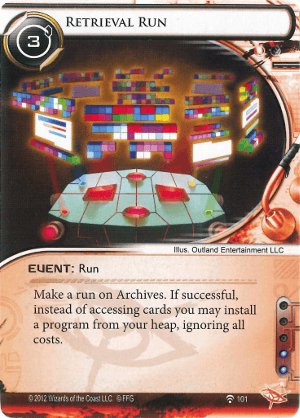
Retrieval Run
If you are the runner, it is a possibility that your best programs will end up in the discard pile.  Sure, you may have extra copies of them in your deck, but it could take time you might not have to dig through your deck.  With this card, you can return a program from your discard into play by making a successful run on Archives.  And since few corporations bother to defend their Archives unless they suspect you are running Sneakdoor Beta, there is a good chance you will not have to break a lot of ice.  So you could use this to get back a program you lost, or to cheaply install an expensive program you discarded in preparation for this.

Pair cards: Femme Fatale, Morning Star, Torch

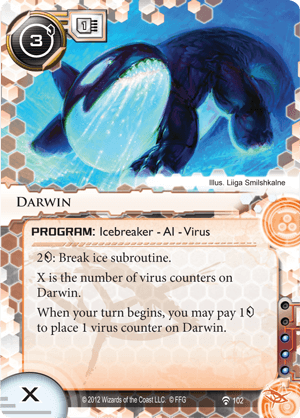
Darwin
This is pretty interesting.  It is an AI icebreaker, so it can get through almost any piece of ice.  It is cheaper to install that Crypsis and likely will not cost as much to use as Wyrm.  The main catch is that the strength is equal to the number of virus counters on this card.  At the start of your turn, you can pay a credit to place a virus counter on it, which builds up very slowly and the corporation can take advantage of by regularly purging viruses.  Still, if you are basing your deck around viruses, this is a decent way to augment your breaker suite.

Pair cards: Déjà Vu, Cyberfeeder, Grimoire, Djinn, Surge, Incubator, Hivemind

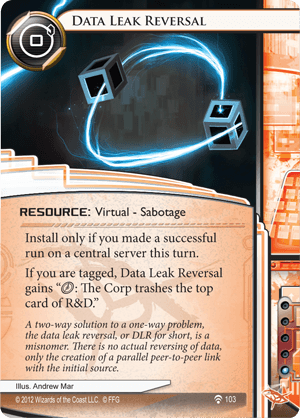
Data Leak Reversal
I think I have mentioned it before, but this is a key part of the 2015 World Championship Runner deck.  It is pretty apparent to see how this card could become so powerful.  Sure, you must have made a successful run on a central server to install it, but unless the corporation ices up all the centrals on turn 1, that can be done fairly easily.  Plus, it has no use unless you have a tag, but again, it is easy enough to do that, especially as part of the combo involves Paparazzi which makes you tagged, and before that, you could use Joshua B. or John Masanori to tag yourself easily.  The big issue is protecting it, which is where Fall Guy and Wireless Net Pavilion complete the combo.  With all of that, you can spend 5 clicks every turn to burn down the corporation, and there is little they can do about it without a massive pile of credits, or a few very specific cards.

Pair cards: Joshua B., John Masanori, Fall Guy, Paparazzi, Wireless Net Pavilion

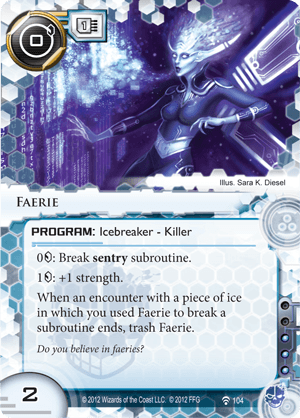
Faerie
Cheap to install and breaks sentry subroutines for free.  There is very little to dislike about Faerie.  Of course, the drawback is that once you use it in an encounter, you have to trash it.  But thanks to recent cards, there is a way around that detail.  Still, even before that, Faerie made a good temporary sentry breaker.  It is something to have out before you get your main killer so you can face check ice without worrying too much.

Pair cards: Test Run, Clone Chip, Baba Yaga

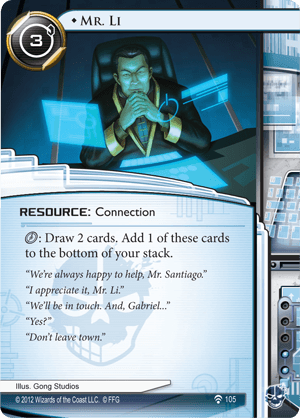
Mr. Li
Sort of a Criminal version of a draw card.  Instead of spending a click for one card, you get to look at two cards, pick the one you want more, and return the other card to the bottom of your deck.  Of course, you may have to make tough decisions regarding what you need now as opposed to what you will need in the future.  Although, this card has seen less play since the addition of other Criminal draw cards such as Lawyer Up and Fisk Investment Seminar.
Trivia: Mr. Li is an ancillary character from the Android board game.  He is a significant member of the tri-maf, and has Sergeant Blaine Louis under his thumb.  Of course, it is possible to gain favors out of him, but doing so may mean you will have to do things that you might find distasteful.

Pair cards: Hostage, Calling in Favors, Window

Indexing
This is very powerful.  If this is successful, you will know what the next 5 cards the corporation will draw are.  There are multiple ways you can use this.  You could just put any agendas on top for an immediate repeat attack on R&D.  Or you could bury traps and other cards that would immediately benefit the corporation.  But probably the biggest benefit is knowing what is coming up, so you can prepare for it in advance.

Pair cards: The Maker's Eye, Data Breach, Top Hat

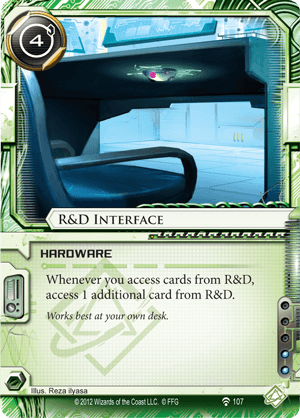
R&D Interface
Like HQ Interface, only in the Shaper faction and used on R&D.  Each copy of this makes you access another card from R&D.  With 1 or 2 of these installed, you can lock down R&D and make it so the corporation is unable to surprise you unless they spend a lot of time drawing cards.  Of course, against certain decks, being forced to access additional cards out of R&D may lead to hitting multiple traps and a flatline if you are not careful.

Trivia: And just like HQ Intefrace, this is also a reprint.  R&D Interface from the Netrunner CCG is exactly the same as this in cost and ability.

Pair cards: Modded, Inside Man, Replicator

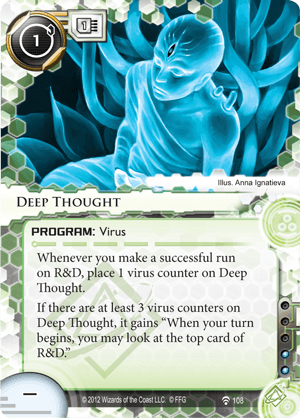
 Deep Thought
Well, this is interesting.  Basically, if you can successfully hit R&D 3 times, then when your turn starts, you can look at the top card of R&D.  So if it is something irrelevant, you do not have to spend time and resources attacking R&D that turn, which you might have done without that knowledge.  Of course, this card might force the corporation to purge viruses periodically, which means they will lose a few turns, or they might over defend R&D, leaving other servers weakened.  Or the corporation might just let you have that knowledge.  As such, this card presents possibilities that are up to you.

Trivia: And we have a reprint.  Deep Thought from the Netrunner CCG has the same effect, where you put counters on R&D for each successful run, and having 3 or more means you can look at the top card of R&D at the start of your turn.  The only difference is the install cost is 0 instead of 1.

Pair cards: Déjà Vu, Cyberfeeder, Grimoire, Djinn, Surge, Incubator, Hivemind

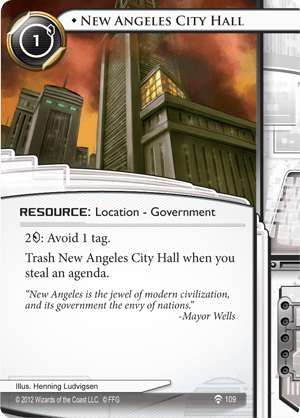
New Angeles City Hall
If you suspect or you know you are going to take tags, then this is a decent card to have.  2 credits to avoid a tag means that you do not have to spend clicks removing that tag in the future.  That means you can use those clicks for more important tasks.  The catch is you have to have the credits before you would be tagged, otherwise you are unable to dodge it.  Plus, as soon as you steal an agenda, you have to trash this, which could mess up your plans early on unless you have a fallback.

Pair cards: Account Siphon, Vamp, Fall Guy

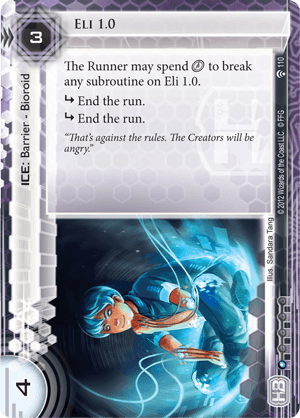
Eli 1.0
For quite a while, this was the word in barriers.  It has more strength than its rez cost.  It has 2 end the run subroutines.  It is a bioroid, meaning the runner can click through the subroutines, but that takes 2 clicks to do so.  It has an influence cost of 1, so it could be easily brought into any faction.  It is a very powerful piece of ice, even into the late game.  That power is probably what led to this card being placed onto the Most Wanted List, making it effectively 2 influence, or 1 influence in faction.  So taking this card means you will be taking less from outside your faction, but it could be decent enough to justify that.

Pair cards: Project Wotan, Awakening Center, Tyr's Hand, Brain-Taping Warehouse, Wetwork Refit

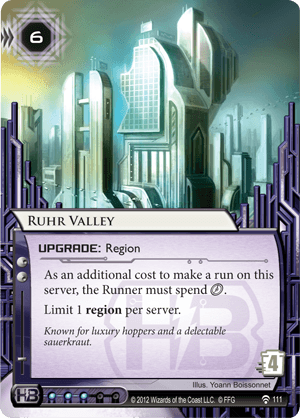
Ruhr Valley
Not frequently played, although it seems fairly useful.  Comparing it to SanSan City Grid which has a similar cost, you can see why people are less likely to choose this card.  The effect is powerful, but it is expensive, and only works on one server.  Plus, it means you are unable to have another region in that server.  Maybe if you have massive amounts of money, this could be an effective deterrent.

Pair cards: Strongbox, Enhanced Login Protocol

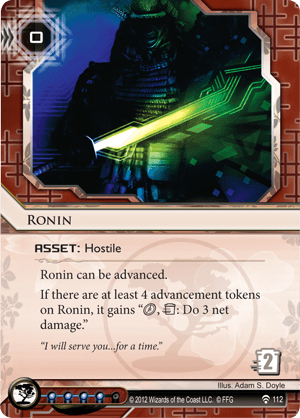
Ronin
An interesting way to set up a kill.  With 4 advancement tokens, you can do 3 net damage to the runner, so if you softened up the runner beforehand, that can be lethal.  As such, you want the runner to think this is an inconsequential card right up to the point where you activate it.  Of course, it is vulnerable in R&D and HQ, and if the runner hits this before you are ready to use it, then the opportunity is gone.  Still, it is significant enough that the winning corporation deck at GenCon 2016 made use of this.

Trivia: A Ronin in feudal Japan was a samurai who served no lord and could be hired.

Pair cards: Trick of Light, Chairman Hiro, Mushin No Shin, Hostile InfrastructureDedication Ceremony, Bio-Ethics Association

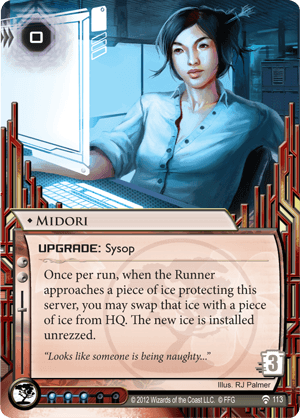
Midori
An interesting idea.  With this on the server, the runner is uncertain exactly what they might encounter running on that server.  Being able to switch out the first piece of ice means that the runner might not be able to break it, or if they were depending on an Inside Job to get past something big, it may be wasted on a smaller piece of ice.  Of course, this is dependent on you having ice in your HQ when that happens, and the new ice comes in unrezzed, so you will need to have enough cash to bring the new ice online.

Trivia: Midori is a Japanese word for "green."  Not sure how that relates to this particular card.  Also, this is sort of a reprint.  Omni Kismet, Ph.D. from the Netrunner CCG has a similar effect, except it can be used on any piece of unrezzed ice in the server.

Pair cards: Akitaro Watanabe, Levy University

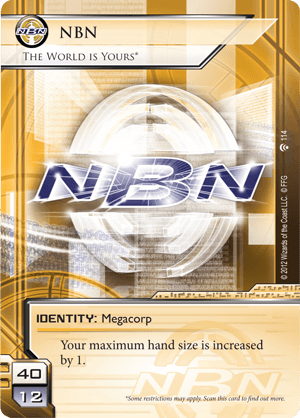
NBN: The World is Yours*
And finally, the first new NBN identity.  This feels like a very different direction from NBN: Making News.  Instead of being able to boost a trace, you can hold an extra card in your hand.  Also, the lower minimum deck size means you can build a more efficient deck.  The drawback is your influence is reduced to 12, meaning that while you could have 3 copies of Biotic Labor or Scorched Earth, that would take up all your influence.  Working with less means you will probably have to choose which archetype of deck you want up front, but you still have a lot of leeway in what direction you want to go.

Pair cards: whatever you feel like

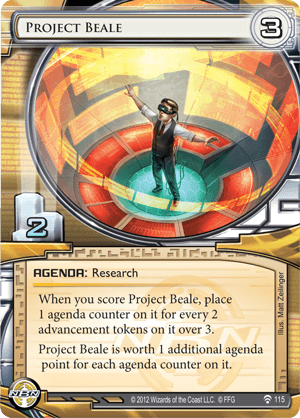
Project Beale
Another 3 advancement tokens for 2 points really benefited NBN, especially with already having AstroScript Pilot Program, as now you had two different agendas that could be scored in one turn with Biotic Labor or SanSan City Grid.  But the really interesting feature of this card is what happens when you over advance it.  Every 2 counters on this over 3 when you score it lets you place an agenda counter on it, and every agenda counter on this makes it worth an additional agenda point.  So with 5 advancement counters, this becomes a 3 point agenda, with 7 it becomes a 4 point agenda, and with a whopping 13 advancement counters, this is worth 7 points and can instantly win a game.  Of course, the runner may not let you advance this card that long, so you will have to come up with a way to place a lot of advancement counters on this at once.

Trivia: A reprint, of sorts.  Project Babylon from the Netrunner CCG is also worth an extra agenda point for every 2 advancement tokens on it above the requirement of 3, except it has a printed agenda score of 1, meaning you need 15 counters on it to make it a 7 point agenda.

Pair cards: Biotic Labor, AstroScript Pilot Program, Psychographics, SanSan City Grid

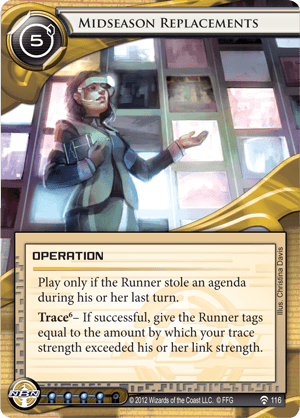
Midseason Replacements
And this is how you get all those tags onto the runner for that massive Project Beale.  The catch is that it is very expensive, and you can only play it if the runner stole an agenda on the previous turn.  Ideally, you would want them to steal something of little consequence, but any agenda will work.  Starting at a trace strength of 6 is very good, and since it gives the runner a number of tags equal to the amount by which you won the trace, you can force the runner to spend most or all of their credits to lower the number of tags.  Or, if they choose not to spend anything, you can still have a pile of tags to take advantage of.  Of course, this does become useless if runner is at the point where stealing another agenda will give them the game, so you have to play this at the exact right time

Pair cards: Closed Accounts, Psychographics, TGTBT, Explode-a-palooza, Lily Lockwell, Exchange of Information, Keegan Lane, BOOM!

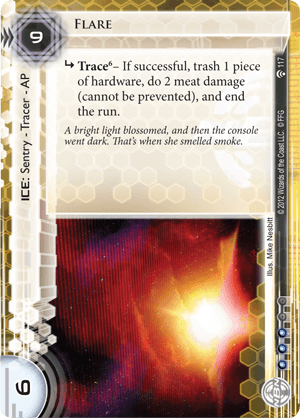
Flare
A very expensive piece of ice, but it has a lot of strength and an interesting subroutine.  If the runner is unable to break this card, then you start a trace with a base strength of 6.  If that trace is successful, you trash a piece of hardware the runner has, do 2 unpreventable meat damage, and the run ends.  The meat damage is common enough, but there are few ways to trash the runner's hardware.  Still, the expense and high strength mean that the runner will look for ways to get around this ice, and if they get very high link strength, they may be able to get past the trace.

Trivia: The Netrunner CCG has a subtype of ice called Firestarters.  These ice are sentries that run a trace with an effect just like the one on Flare.  Perhaps the closest card to Flare would be Cinderella, which has the same strength, a rez cost of 8, and a trace maximum of 6.

Pair cards: NBN: Making News, Primary Transmission Dish, Improved Tracers, Aryabhata Tech

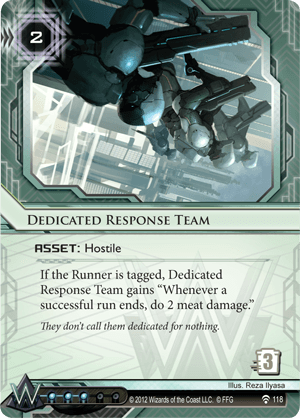
Dedicated Response Team
Tagging the runner mid run is typically possible.  Plus, sometimes the runner will play cards that tag themselves, such as Account Siphon or Vamp.  With this, you can catch the runner by surprise or dissuade them from making runs while tagged.  Of course, if you know they are going to become tagged, then you could potentially get more use out of this.

Pair cards: Snare!, Data Raven, Bernice Mai, TGTBTManhunt, Prisec

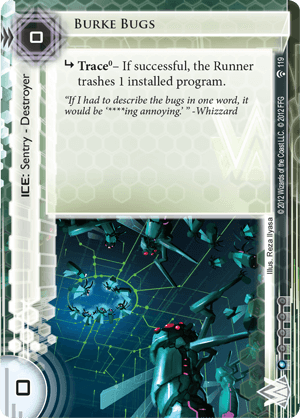
Burke Bugs
It is very hard to come up with a way to make this work.  It is free to rez, which could be a plus, but it has no strength, so it is broken or destroyed easily.  Plus, the one subroutine starts a trace with a base strength of zero.  This means you will be spending credits on that trace to make it successful, and you have to have more credits than the runner for a chance at success.  We could pair this with Improved Tracers, but it does not have the tracer subtype, so that would just raise the trace strength by one.  Still, maybe we should think of this as not a piece of ice, but instead a tax the runner has to pay.

Pair cards: Security Subcontract, Primary Transmission Dish

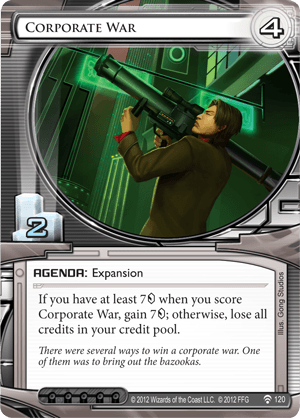
Corporate War
Fairly interesting.  If you have enough money when you score this, you gain even more money.  Of course, if you do not have that money, you lose all your money.  So while you could score this easily in two turns, you may want to hold off on doing so to build your credit pool back up, unless you have very little or no credits to lose.  Still, most people tend to pick other agendas in place of this one.

Triva: Sort of a reprint here.  Corporate War from the Netrunner CCG has an advancement requirement of 3, is worth 3 agenda points, and gives you 12 credits if you have 12 or more credits in your pool, and you lose it all if you do not.  Somewhat more risky then than what it became.

Pair cards: money making cards

And that is all for the Genesis cycle.  Next time, we return to Haas-Bioroid to find out what they are up to in the first deluxe expansion, Creation and Control.
Thursday, March 16, 2017

Card Analysis - Humanity's Shadow

We have gone two-thirds of the way through the Genesis cycle now.  We have expanded the themes of all the major factions, and hinted at new themes.  For now, we move into the second-to-last pack, Humanity's Shadow, and see what more there is to this cycle.

Surge
This is pretty significant.  Almost all virus programs get counters placed on them, either when they are installed or when certain conditions are met.  With this, you could get 2 additional counters on one of your viruses.  So a Crypsis could break two additional pieces of ice.  Or you could access two more cards from R&D if you use this with a Medium.  The biggest issue is that you have to have placed at least one virus counter on a program to use this, but there are some ways to do that outside of the normal methods.

Pair cards: most viruses, Incubator, Virus Breeding Ground

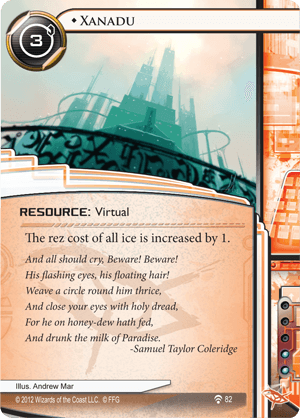
Xanadu
This is quite interesting.  It is unique, which means only one copy can be in play at a time, but that one extra credit can start adding up if the corporation is dependent on a lot of ice.  Cheap ice becomes less cheap and expensive ice becomes more expensive.  This could significantly throw off the corporation's math on what they are able to defend if you install this just before you make a run.

Trivia: The flavor text comes from the Samuel Taylor Coleridge poem, "Kubla Khan; or, A Vision in a Dream: A Fragment."  Xanadu is the poem is in reference to Shangdu, China, which was the capital of Kubla Khai's empire during the Yuan dynasty.

Pair cards: Forged Activation OrdersCrescentus, Social Engineering

Andromeda: Dispossessed Ristie
And finally, the first new Criminal identity.  Andromeda does not have an ability that is useful throughout the entire game, but instead starts the game with 9 cards.  This means that you have many more options in your first turn, and you can get through your deck quicker, if that is your objective.  Plus, she starts with a base link strength of 1, so you do not need to spend as much on traces.  A fairly solid identity if you need to jump start your game.

Pair cards: anything

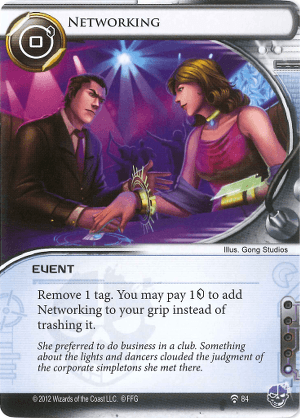
Networking
Not frequently used, but it does have some potential.  You can use this to remove a tag for free, but spending 1 credit returns this to your hand.  So you could essentially cut the cost to remove each tag in half.  Of course, this presumes you expect the corporation to tag you.  But if you are running cards that force you to tag yourself, this could be a decent way to remove those tags at a cheaper price.

Trivia: This card is a reprint.  From the Netrunner CCG, we have Open-Ended® Mileage Program, which does the exact same thing as Networking, up to being able to return it to your hand for a credit.

Pair cards: Account Siphon, Vamp, Code Siphon, Maya

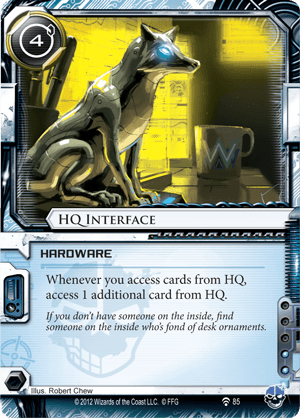
HQ Interface
Accessing additional cards is almost always a good thing.  Each copy of this means you access 1 more card from HQ.  Unlike Nerve Agent, the additional access is mandatory, so you might end up flatlining yourself if your opponent decided to hold traps in their hand.  Otherwise, being able to access extra cards means you have more knowledge about what your opponent can do.

Trivia: Also a reprint.  The Netrunner CCG has a card named HQ Interface, with stats pretty much the same as this card.

Pair cards: Demolition Run, Modded, Inside Man

Pheromones
If you know that you will be making a lot of runs on HQ, here is a way to help offset the cost of doing so.  Each time you make a successful run on HQ, you place a virus counter on this card.  Each virus counter on this card adds a recurring credit to this card that can only be used during runs on HQ.  So the more you run on HQ, the more you could get out of this card.  Just watch out for when the corporation decides to purge viruses.  Also, you may have to wait until the start of your next turn for the new credits, as that is when recurring credits are replaced.  Although, the FAQ say that recurring credits are replaced up to the current value, so if you have credits on this before the corp purges, it looks like you keep them.

Pair cards: Surge, Hivemind

Quality Time
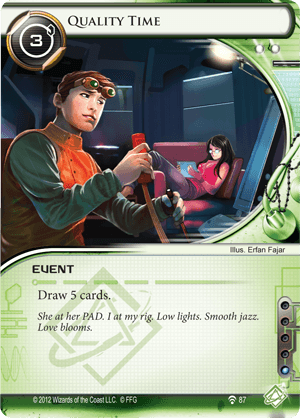
A bigger version of Diesel, this card lets you draw 5 cards.  Unlike Diesel, you have to pay 3 credits to play this card.  So you may be wondering why you would need so many cards at once.  Well, there are decks geared around holding onto a lot of cards at once.  Also, this can be a decent way to rebuild your hand if you took a lot of damage or played out a lot of cards.  Plus, there is the fact that this card only costs 1 influence instead of the 2 you need for Diesel, so if you need card draw but are tight on influence, this could be a decent choice.

Trivia: Another reprint here.  From Netrunner CCG, we have the card Bodyweight™ Synthetic Blood, which has the exact same effect, but costs 2 credits to play.

Pair cards: Public Sympathy, Freelance Coding Contract, Prepaid VoicePAD, Beach Party, Faust

Replicator
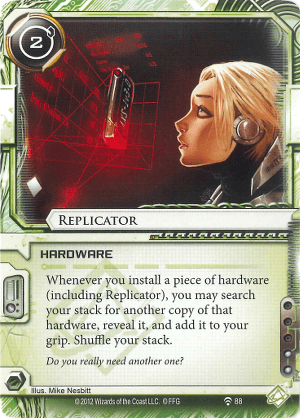
Okay, this is intriguing.  Having this installed means you can take copies of hardware that you install from your deck.  Sure, it means you can install another copy faster, but the added bonus is you are thinning cards out of your deck, making it more likely you will draw into other cards you need or want.  If your deck is really hardware intensive, having 2 or 3 copies of this could be quite beneficial.

Trivia: Possibly a callback to Android: Infiltration.  One of the item cards in that game is Replicator, which allows you to search through the discard pile and take an item of your choice into your hand.  It even uses the same art.

Pair cards: all hardware, Inside Man, Bazaar

Creeper
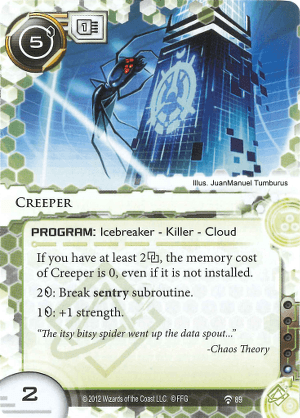
A sentry breaker that is also a killer.  It seems fairly solid, although it is moderately expensive to install.  The bigger drawback is the 2 credit cost to break a subroutine, which can add up as many sentries have 2 or more subroutines.  Of course, if you need space in your rig for other programs and can easily get the link up, this might not be too bad.

Pair cards: link strength, e3 Feedback Implants, Security Chip

Kraken
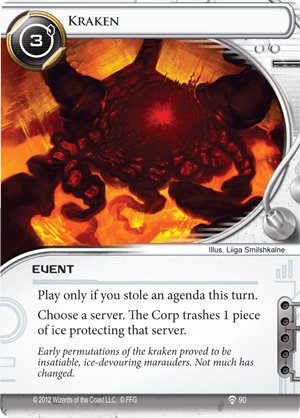
Not frequently played, mainly because of the requirement.  You must have stolen an agenda on the same turn in order to play this, so you have to know there is an agenda and that you can get to it.  Playing this could take out a large piece of ice, but you only get to choose which server it is from.  The corporation will be choosing which piece of ice to trash.  Still, if they are piling up expensive ice on one server, this could be a cheap way to knock one out.

Pair cards: Inside Job, Infiltration, Prepaid VoicePAD

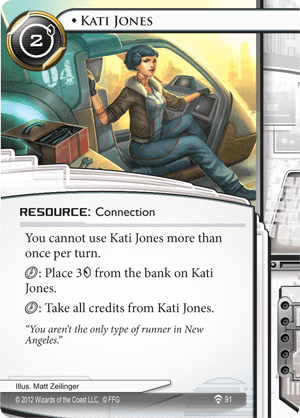
Kati Jones
A very excellent form of economy, if you are willing to put time in.  For each turn, you can either put 3 credits onto this card, or you can take all the credits off of it.  So ideally you want to build up a lot of credits before you need them, say for making a run or installing a lot of cards.  The big drawback is the card being unique means you can only have one copy in play at a time, but by keeping this safe, you can have a fairly stable form of burst economy.

Trivia: Yep, another reprint here.  The original Netrunner CCG card was called Broker, except it cost 3 credits to install and was not unique, so you could have had multiple Brokers installed at the same time.

Pair cards: Hostage, Fall Guy, Calling in Favors, Off-Campus Apartment

Eve Campaign
Like Adonis Campaign, this has the potential to pay out a lot of money to the corporation.  However, the money from Eve Campaign comes in much slower.  At only 2 credits per turn, it will be 3 turns before this pays for itself, making the default profit 11 credits.  The upside is that the 5 credit trash cost may keep the runner from trashing this, especially since you are not getting a lot of credits from it each turn.

Pair cards: Breaker Bay Grid, Ad Blitz, Mumba Temple

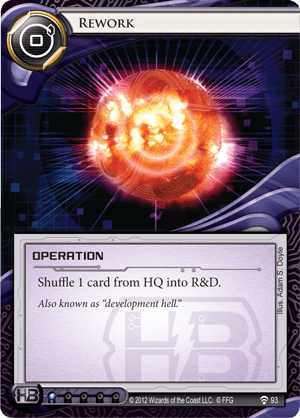
Rework
Sort of a double-edged sword.  On the one hand, you can put an agenda or other card you do not want the runner to see back into the deck.  On the other hand, this signals to the runner that you may have just removed something important from your hand, meaning they can focus more on attacking R&D.  Plus, this takes up deck space.  It could be seen as a way to extend the game, meaning you could get more turns by running this, but other cards could potentially end the game in your favor sooner.

Pair cards: anything

Whirlpool
An interesting concept.  Because this is a trap, it means that the runner will need an AI in order to break this.  Of course, you will want to place this so that it forces the runner into a trap, which means placing it in front of an ice that can end the run is a poor idea, since they could let that subroutine go off and evade your trap.  Still, there are possibilities that could be used with this.

Pair cards: Project Junebug, Snare!

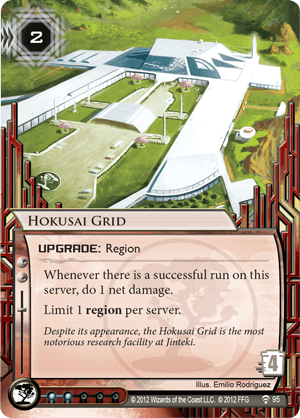
Hokusai Grid
This is interesting.  Having this card means that the runner will take damage on a successful run.  Pair that with other sources of damage and you can flatline a runner who is not cautious enough, or you could force them to overdraw for little to no effect.  With a trash cost of 4, you may get several uses out of this, as you will typically want this on your scoring server or possibly R&D or HQ.

Pair cards: Jinteki: Personal Evolution, Project Junebug, Snare!, Fetal AI

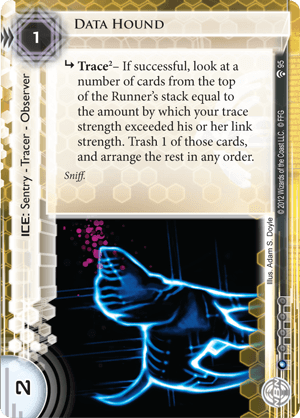
Data Hound
In theory, this could be interesting.  It is cheap to rez, but has low strength and the one subroutine is dependent on a trace.  But if that trace is successful, you get to look at a number of cards off the top of the runners deck equal to the amount by which you one the trace.  You can then trash one of them and rearrange the rest in any order.  So you could get rid of something important to the runner and bury other good cards deeper in their deck.  The problem is that once they have their killer up, this becomes very irrelevant.

Trivia: Sort of a callback to Emergency Shutdown, as the artwork from that card is very similar to this card, which is likely because artist Adam S. Doyle did the art for both cards.

Pair cards: NBN: Making NewsPrimary Transmission Dish, Improved Tracers

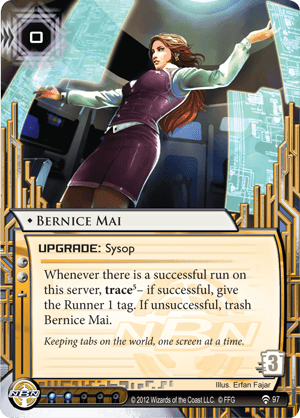
Bernice Mai
Free to rez and a modest cost to trash.  This could be a decent way to land a tag on the runner.  Of course, they have to make a successful run on the server she is installed in, and you have to make a successful trace.  Still, it is a somewhat high trace to start with, so unless the runner has gone high link or has a lot more cash than you, you may have a good chance of landing that trace.

Pair cards: NBN: Making NewsPrimary Transmission Dish, Recruiting Trip

Salvage
Completing the trinity with Woodcutter and Tyrant, we have Salvage.  Very cheap to rez, this card gains a subroutine that could give the runner a tag for every advancement token on it.  The drawback is the low strength, meaning that most decoders will be breaking this for 1 credit per subroutine, and Yog.0 breaks it for free.  Worse, it dies immediately to Parasite, meaning any money you spent advancing this is lost.  Still, it is a Wayland card in faction that can tag the runner, so if you absolutely need another way to try and give them a lot of tags, maybe this is worth considering.

Trivia: The flavor text is a reference to The Wizard of Oz, with Dorothy remarking to Toto, "I've a feeling we're not in Kansas anymore."

Pair cards: Amazon Industrial Zone, Primary Transmission Dish, Improved Tracers, Dedication Ceremony

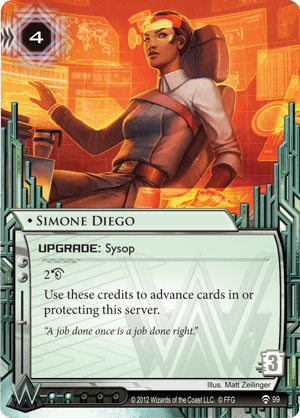
Simone Diego
At 4 credits to rez, this is one of the more expensive Sysops yet.  But she has two recurring credits that can be used to advance cards in or protecting the server she is in.  So if you place her in your scoring server, you could install an agenda and then advance it using the credits on Simone.  That frees up credits in your pool for the defense of your scoring server or your other server.  Plus, if the ice on the server can be advanced, you can use the credits on Simone to boost them.

Pair cars: Recruiting Trip, Breaker Bay Grid

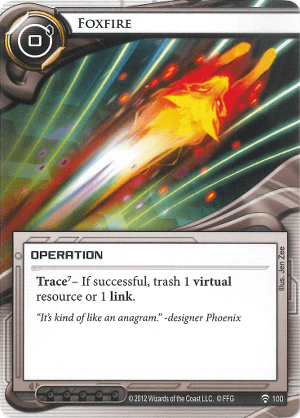
Foxfire
Not frequently used, mostly because it is very situational.  Because it can only destroy virtual resources or link subtype cards, if the runner is not playing any of those, this becomes a dead card.  But if they are dependent on one of those, you might take it out easily, as this card starts with a very high trace strength.

Trivia: As the flavor text implies, Foxfire is sort of an anagram for Firefox, a popular web browser.

Pair cards: NBN: Making NewsPrimary Transmission Dish

And that is all for Humanity's Shadow.  Next time, we finish off the Genesis cycle with Future Proof.

Wednesday, March 15, 2017

Card Analysis - A Study in Static

We have gone halfway through the first cycle, but there are still plenty of cards left to look at.  As such, it is time to look at the fourth pack in the Genesis Cycle, A Study in Static.

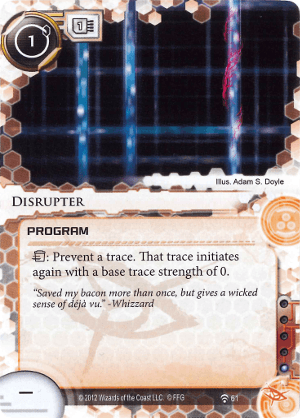
Disrupter
Not a great card, as most of the traces are initiated by the corporation, so you are more dependent on them.  There are some corporation cards that do have a large trace strength, so it is kind of good in case one of those come up.  However, the ruling is that you have to use this card at the start of a trace, before the corporation spends any credits, so you are unable to make the corporation spend credits twice on the same trace.

Pair cards: Security Nexus

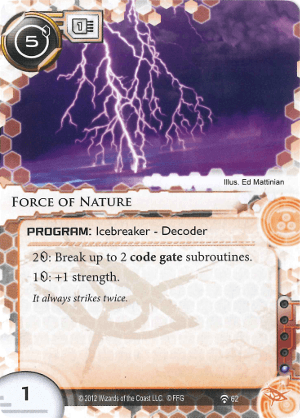
Force of Nature
Moderately expensive to install, and somewhat inefficient, as it costs 2 credits to break 1 or 2 subroutines.  The major reason to choose this over other decoders is probably influence.  This only costs 1 influence per copy, whereas other decoders so far tend to take 2 or 3 influence.  But since Shaper already has Gordian Blade in faction, you would probably get more use out of this by running it in a Criminal deck, as then you will probably be making enough money to pay for the cost of using this.

Pair cards: Cyberfeeder, Datasucker, e3 Feedback Implants, Multithreader

Scrubber
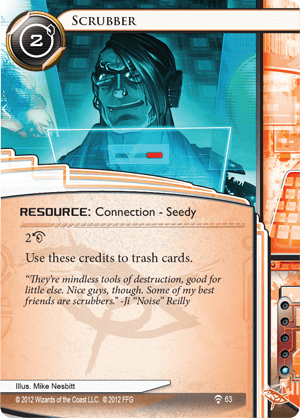
The big thing about recurring credits is that the more you use them, the more money you will have for other costs.  With Scrubber, you pay less out of your credit pool to trash cards.  So with this, you could make trashing expensive assets and upgrades cheaper, or destroy small things for free.  This card can be devastating to a corporation that depends upon having a lot of assets for economy.

Pair cards: Hostage, Calling in Favors

Doppelgänger
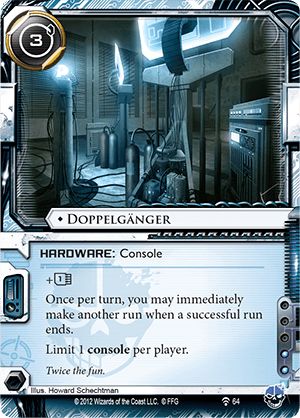
Being a Criminal console, this is immediately compared to Desperado.  The drawback is that Desperado can be used multiple times per turn, whereas this can only be used once per turn.  If you know you can or have to make an extra run, then this could be better than Desperado, but you will likely have to make up the cash you would have otherwise earned elsewhere.

Trivia: I suspect that this console belongs to Ken "Express" Tenma: Disappeared Clone, as it fits his them of near constant running.

Pair cards: Notoriety, Quest Completed

Crescentus
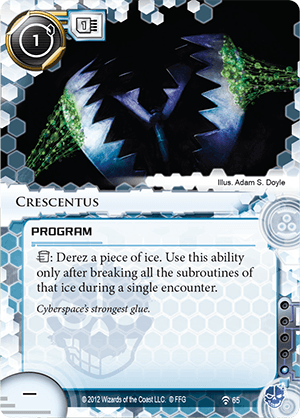
I think I mentioned before with Emergency Shutdown that derezzing a piece of ice can be very good for the runner, especially if it was expensive for the corporation to rez.  With this card, you are able to derez a piece of ice immediately after breaking all of the subroutines on it in one encounter.  Of course, that means you need to have this card installed, and it does take up a point of memory, but recent builds of Armand "Geist" Walker: Tech Lord can take great advantage of this card thanks to the breaking and entering suite of icebreakers.

Trivia: Turns out this card is a reprint.  From the Classic expansion of the Netrunner CCG we have Superglue, which functions exactly the same as Crescentus, but costs 2 to install.

Pair cards: Spike, Crowbar, Shiv

Deus X
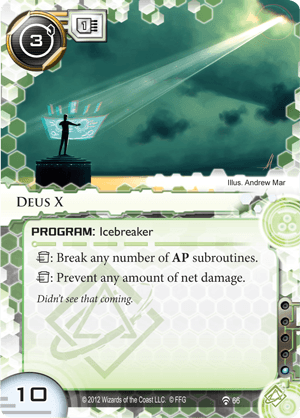
Not frequently used, but it has great potential.  It can prevent any amount of net damage, which means you have less to fear from Project Junebug or Snare!.  But it can also be used to break all the subroutines on a piece of AP ice, which also do damage.  This is really good in case of emergencies.

Trivia: The name comes from the Latin phrase, "deus ex machina," which can be translated as, "miracle from the machine."

Pair cards: Clone Chip, Self-modifying Code

All-nighter
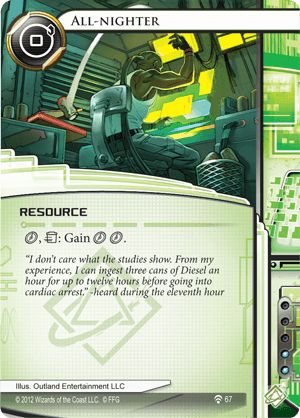
While the obvious thing to say is that this is the runner equivalent of Biotic Labor, it really is not.  Biotic Labor is purchasing a click, while All-Nighter is more like storing a click for later.  Think about it this way.  You spend a click to install All-Nighter, and at a later point in time, you trash All-Nighter to gain a click.  Basically, you have moved a click from one turn to another turn.  So why would you want to do that?  Well, if you need more clicks on a single turn, such as to break through bioroid ice, then this is a solid way to have a longer turn.  But there are other cards that can make better use of more clicks.

Trivia: There is a card from the Netrunner CCG called All-Nighter, but it is a prep card, and instead of giving you extra actions, you make a run, after which you can make another run.

Pair cards: Wanton Destruction, Always Be Running

Inside Man
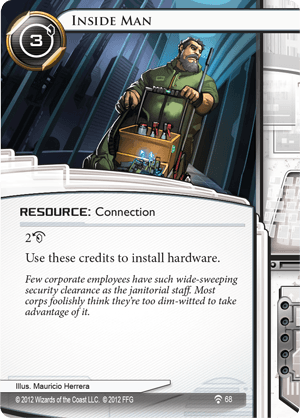
Suppose your deck has a lot of hardware.  Massive amounts of it, to the point where you are installing hardware every turn.  Well, this card can help offset the cost.  It does take two turns of using this card before it has paid for itself, which could be a problem, but you could try to use if your economy needs a small boost.

Trivia: The artwork and flavor text are a reference to Android: Infiltration.  One of the playable characters from that game is Hugo Cash, referred to as the Inside Man, who works as a janitor at CyberSolutions, Inc, because an android replaced him at his previous job.

Pair cards: all hardware, Hostage, Calling in Favors, Career Fair, Bazaar

Underworld Contact
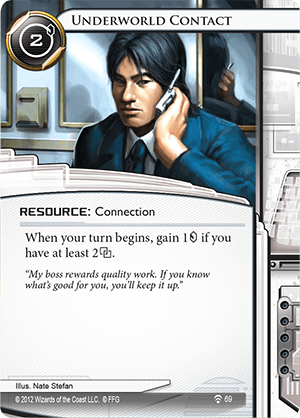
A really good drip economy card for the runner.  All you have to do is get your link strength up to 2.  Granted, if your base link is 0, that could take some effort, but many runners start with 1 base link, meaning they only have to install one card to activate this.  With three copies installed, you can make 3 credits per turn, equivalent to playing a copy of Easy Mark each turn without spending a click.

Pair cards: anything that adds link strength, Hostage, Calling in Favors

Green Level Clearance
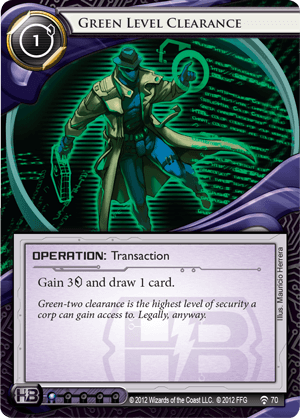
This card exemplifies the click compression available in Haas-Bioroid.  For one click and 1 credit, you get back 3 credits and a card.  Basically, you get 4 clicks worth out of a click and a credit.  Plus, the low play cost means that it is easy enough to play this card, even if you are reduced to 0 credits.

Trivia: The closest we get to this from the Netrunner CCG is Night Shift, which costs 0 to play and gives the corporation 2 credits and 1 card.

Pair cards: anything

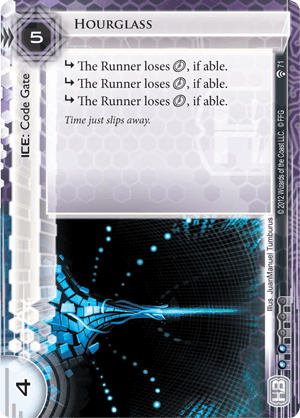
Hourglass
I have somewhat mixed feelings about this.  Surprising the runner with this means they could lose the rest of their turn, but afterwards they will likely just run on their last click so they can ignore this piece of ice.  Plus, it is moderately expensive to rez, which means you will have significantly less money on your turn.  Still, there are a few potential combinations with this piece of ice that are possible.

Pair cards: Heinlein Grid

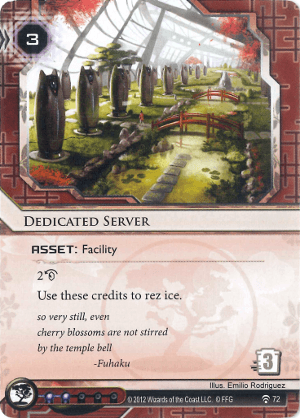
Dedicated Server
Not a card that has seen a lot of play.  The rez cost means that you will have to use this twice before it pays for itself, and the trash cost is low enough that the runner will likely destroy it if you do not have some defenses or punishment in place.  Your credits and deck slots might be better used, but if you think you need the recurring credits, maybe it is worth trying this.

Pair cards: Diversified Portfolio, Hostile Infrastructure, Breaker Bay Grid

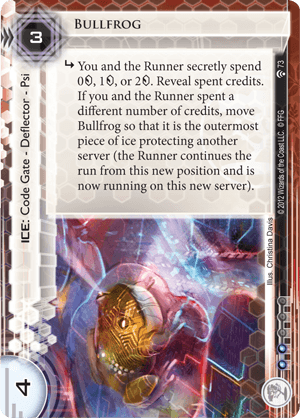
Bullfrog
Somewhat interesting.  Instead of stopping a run, if this goes off, you can redirect the runner onto another server.  So you could force the runner away from your scoring server onto a central server, or from a central onto a remote, or wherever you want them.  Of course, this is dependent on you spending a different amount of credits than the runner, and the runner being unable or unwilling to break this.

Trivia: There are a series of ice cards from the Classic expansion to the Netrunner CCG that have the subtype Deflector.  They function similarly to Bullfrog, except that they have to be installed on specific servers and redirect to other specific servers.  That series includes: Dumpster, Entrapment, Trapdoor, and Vortex.

Pair cards: Encrypted Portals, Hyoubu Research Facility

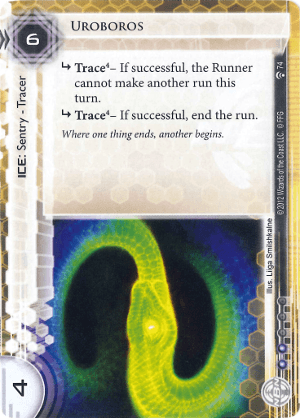
Uroboros
Fairly interesting.  Somewhat average strength for the rez cost, and capable of ending a run.  Of course, that is dependent on winning a trace.  Plus, it can possibly prevent the runner from making additional runs, which could throw off the plans the runner had for the turn.  Still, if the runner has gone with high link strength, this card may be ignored by the runner.

Trivia: A reference to the Ouroboros, an image of a serpent eating its own tail, symbolizing the endless cycle of creation and destruction.

Pair cards: Primary Transmission Dish, Improved Tracers

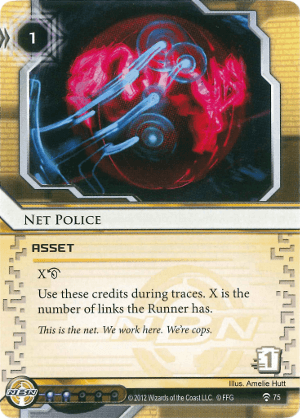
Net Police
Kind of interesting.  This allows you to nullify the link strength of the runner for one trace.  The low rez cost means that you will almost always be able to activate this, but the low trash cost means that the runner will be able to easily destroy this card.  Still, for those critical traces, this could be quite beneficial.
Trivia: The flavor text seems to be a reference to Dragnet, specifically the introduction, where Joe Friday narrates, "This is the city, Los Angeles, California, I work here. I'm a cop."

Pair cards: anything that traces, Turtlebacks, Diversified Portfolio

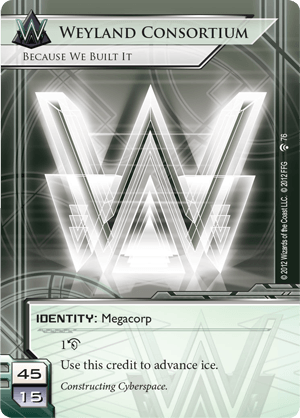
Weyland Consortium: Because We Built It
Having an extra credit each turn sounds like a good thing.  The problem is that this credit can only be used to advance ice, which means to get use out of it, you have to spend a click each turn advancing ice.  So with this, you want to fill your deck with ice that can be advanced.  Still, most other Weyland identities seem to give a lot more benefit than this one.

Pair cards: Trick of Light, Constellation Protocol

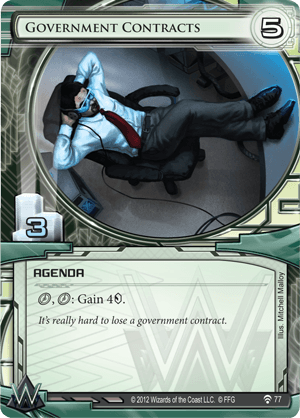
Government Contracts
The ability is very nice, essentially giving you 2 credits a click, at the cost of 2 clicks.  The drawback is that it is a 5 advancement cost agenda, and a 3 pointer.  Sure, being a 3 point agenda means fewer agendas have to go in your deck, but it also means the runner has to steal fewer agendas in order to win.  Still, if you can manage to score one of these, it means you have a fairly efficient economy for the rest of the game.

Pair cards: anything

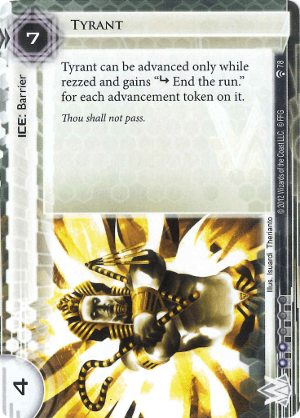
Tyrant
Like Woodcutter, this card gains subroutines from being advanced, and can only be advanced while rezzed.  Although, this card might be a bit more solid than Woodcutter, since it can actually stop a run when advanced.  Plus, each advancement token on it potentially means that it will cost more for the runner to break, so you could pile on advancement tokens.  Still, it will take a lot of resources to make this viable.

Pair cards: Amazon Industrial ZoneCommercialization Executive Boot Camp, Dedication Ceremony

Oversight AI
Suppose you need to get a piece of ice online, but you do not have enough credits in your pool to do so.  Well, with this card, you could bring any piece of ice online, ignoring all the costs.  The catch is that you host this card onto that piece of ice, and if the runner manages to break all the subroutines in an encounter, then the ice is trashed.  But, you could still open enough of a scoring window to get an agenda or two through, or possibly use that ice in another way.

Trivia: There does not seem to be an exact reprint here, but there were a few cards in the Proteus expansion of Netrunner CCG that allowed you to rez ice while ignoring the cost.  Emergency Rig lets you rez a piece of ice by paying any amount of money, but then you put that many counters on that ice and remove one each turn.  When the ice runs out of counters, it is trashed.  Rent-to-Own Contract rezzes a piece of ice for free, but puts a number of counters onto that ice equal to the rez cost.  At the start of your turn, you have to pay 2 credits and remove a counter, or else you add another counter to that ice.

Pair cards: Archer, Janus 1.0, Curtain Wall

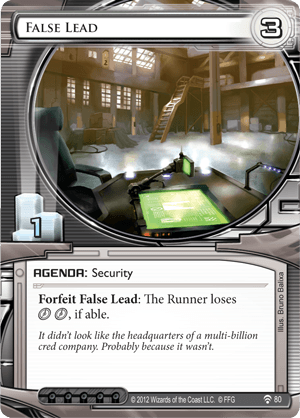
False Lead
This does not seem like much, but it does have some potential.  By forfeiting this, you force the runner to lose 2 clicks.  Of course, they have to have at least 2 clicks, otherwise this does nothing.  But the threat posed by having one of these available means that the runner has to be more cautious with their turn, because at any time the could suddenly be out of time, which you could use to set them up for a kill or to score out an agenda.

Pair cards: Enhanced Login Protocol, Heinlein Grid, Jemison Austronautics: Sacrifce. Audacity. Success.

And that is all for A Study in Static.  Next time, we take a look into Humanity's Shadow.